

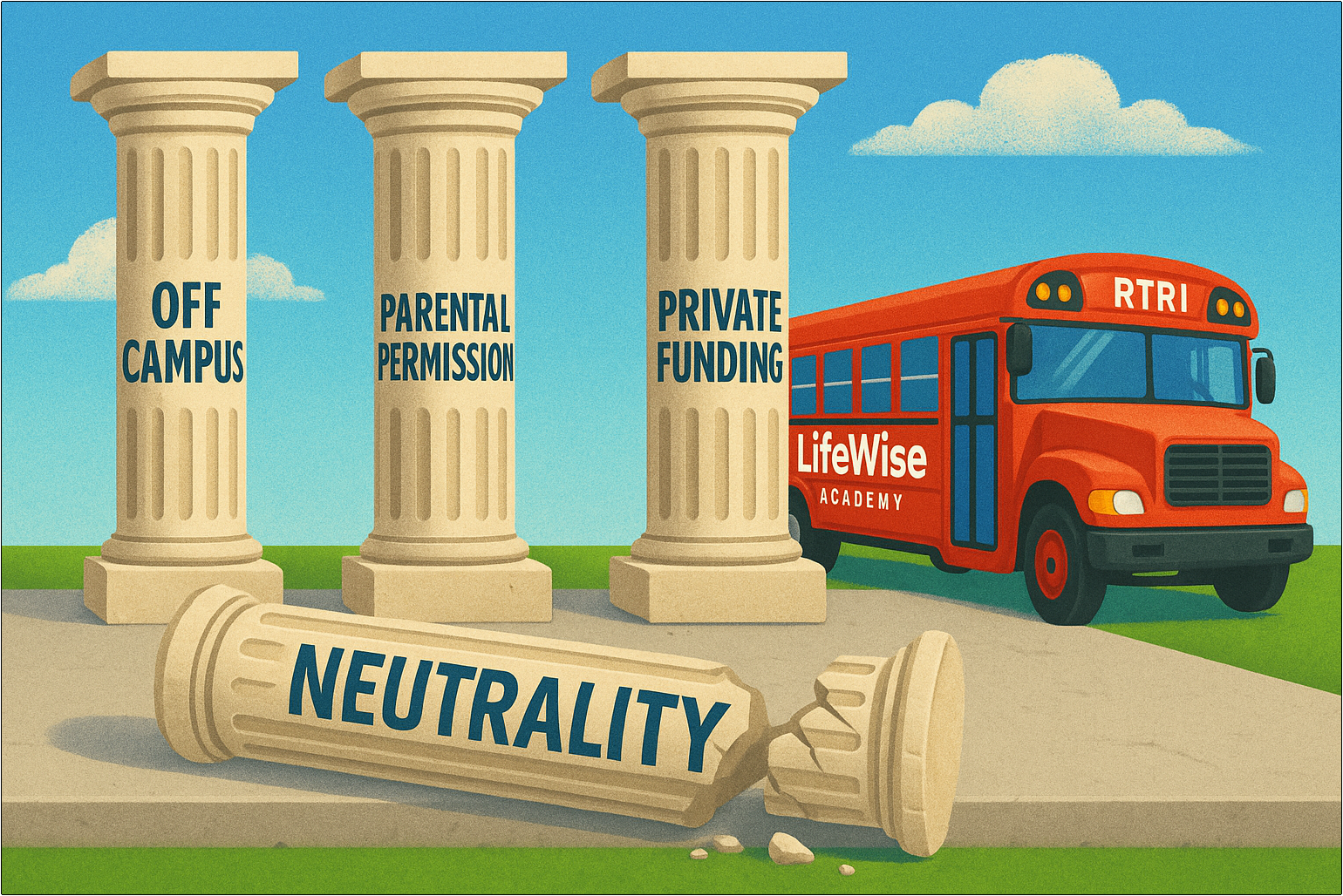
Note: This is Part 1 of the multi-part series Lies By Omission During School Hours. The series examines how LifeWise’s oft-repeated legal formula — “off school property, with parental permission, and privately funded” — omits the constitutional requirement public schools remain neutral toward religion (thus RTRI programs).
Installments explore how LifeWise’s omission of school neutrality reshapes public perception, impacts RTRI implementation, and undermines school district impartiality.
Unless otherwise noted, all bold emphasis is solely attributable to LifeWise Exposed.
LifeWise Academy states again and again release-time religious instruction (RTRI) is legal if three criteria are met:
Off school property (LifeWise’s documentary also bears this name)
Privately funded
Parental permission
From Zorach v. Clauson (1952), these three talking points have become a kind of RTRI “legal holy trinity” — central to LifeWise’s public messaging and marketing — but one critical element of federal law is consistently omitted by LifeWise: public schools must remain neutral toward RTRI programming.
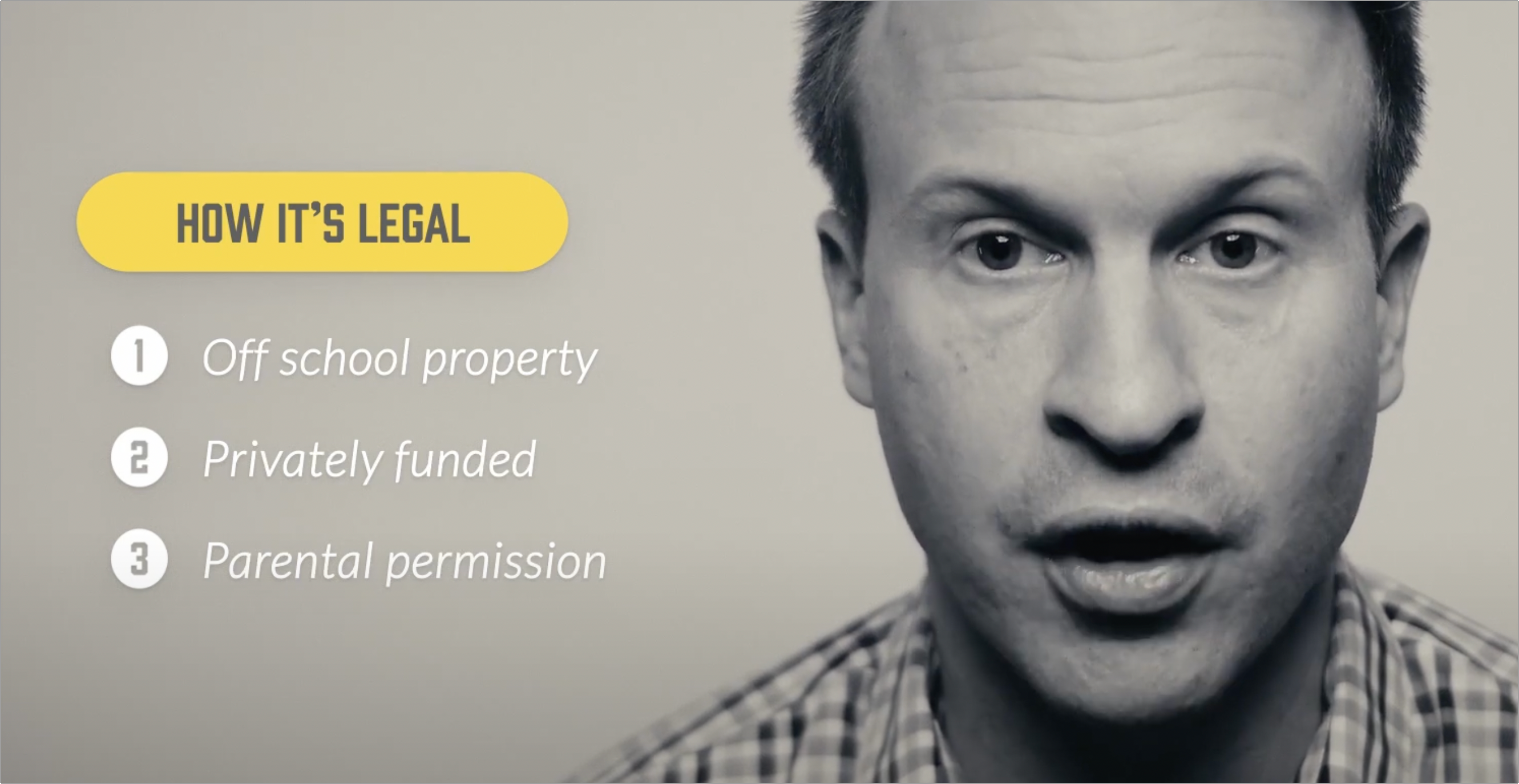
In How is This Legal?, LifeWise’s attorney, Jamie Kresge of Ashbrook Byrne Kresge Flowers, says RTRI is legal and repeats the same three “legal holy trinity” talking points.
“…as long as those three pillars are met, there is no issue. This is clearly legal.”
However, Kresge never states public schools’ neutrality on RTRI is legally required.
This omission is observed again in the LifeWise FAQ:
“The Supreme Court ruling (Zorach v. Clauson, 1952) makes it both constitutional and legal for communities across the country to establish religious programs like LifeWise Academy that meet the three conditions outlined by the ruling: the programs are off school property, privately funded and parent permitted.”
However, the majority opinion in Zorach was explicit regarding government neutrality:
“The government must be neutral when it comes to competition between sects. It may not thrust any sect on any person. It may not make a religious observance compulsory.”
In upholding New York City’s released-time program in Zorach, the Court emphasized that the program’s constitutionality rested on the school’s neutrality — that it neither promoted nor inhibited religion, but merely accommodated voluntary participation.
LifeWise CEO Joel Penton repeats incomplete RTRI legality ‘Off School Property, with Parental Permission, and Privately Funded’ again and again
When speaking on RTRI legality, LifeWise CEO Joel Penton repeats “Off school property, with parental permission, and privately funded” ad nauseum.
February 2025: With Pete Hegseth on Fox News.
September 2024: In the LifeWise Basics Webinar.
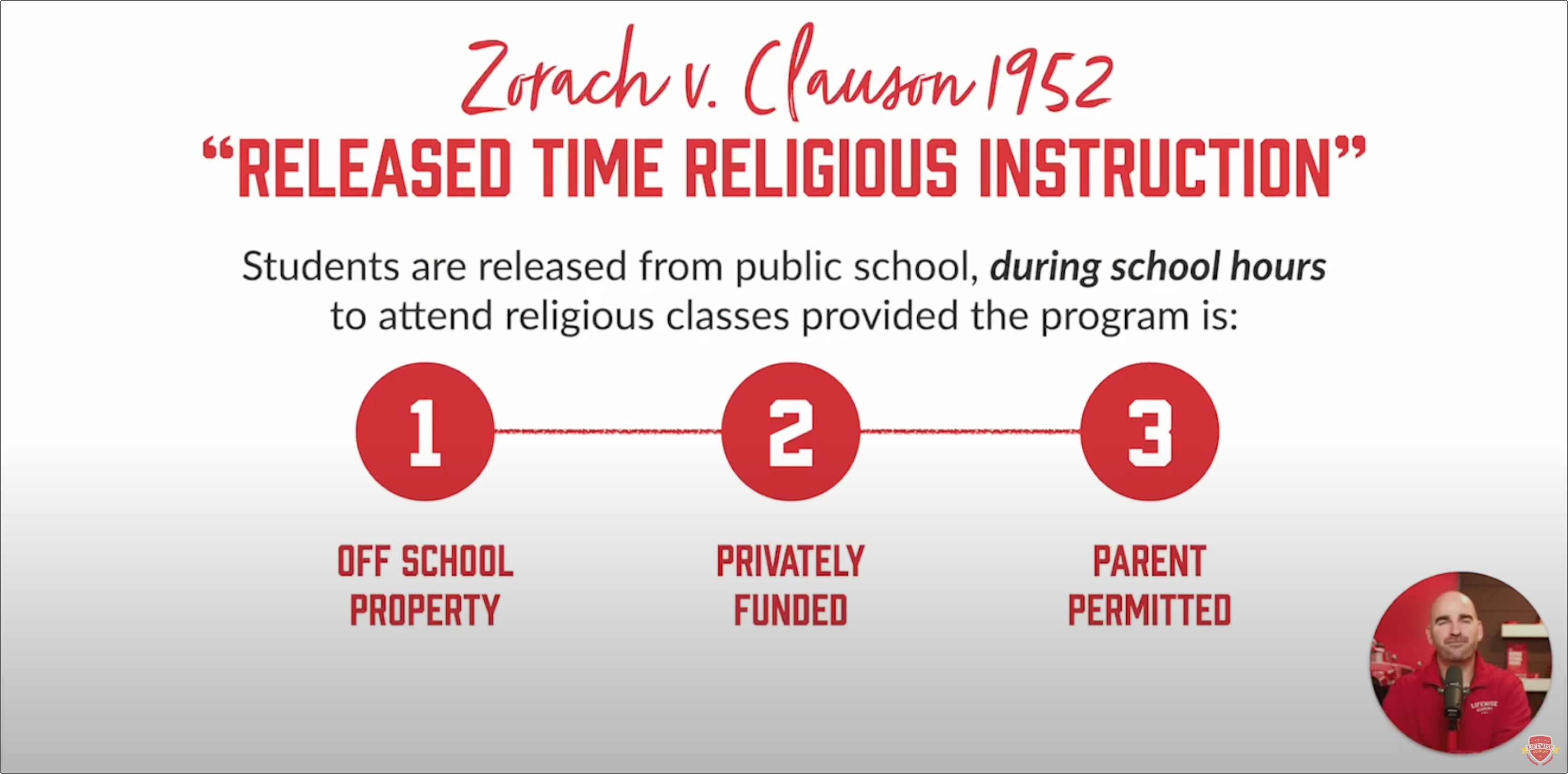
August 2023: On Washington Watch with Tony Perkins, president of Family Research Council.
June 2024: On the Culture & Christianity: The Allen Jackson Podcast.
Penton also repeats this incomplete version of RTRI legality —
here with Jeremy Beer, senior follow of the Center For Civil Society.
— but at no point is the constitutional requirement of public school neutrality toward RTRI programs mentioned by Penton.
LifeWise’s incomplete RTRI ‘Legal Holy Trinity’ is repeated over and over again by external parties
Failing to acknowledge the RTRI legal requirement of public school neutrality, LifeWise has repeated the phrase “off school property, with parental permission, and privately funded” so persistently the organization has effectively shaped the de facto public understanding of RTRI’s legal boundaries — a narrative now echoed, largely unquestioned, by LifeWise’s supporters, much of the media, and many public school districts.
Considering the legality of RTRI is not widely known, it is unsurprising LifeWise’s incomplete RTRI ‘legal holy trinity’ has dominated communications nationally following the program’s rapid national expansion projected to reach nearly 100,000 students across 34 states for the 2025-2026 school year.
Prior to his assassination in September 2025, Turning Point USA CEO Charlie Kirk endorsed LifeWise Academy by quoting the incomplete RTRI legal requirements proliferated by LifeWise.
“…they said the school has to actually allow one hour a week, during school hours, for a kid to be able to have religious instruction. But it has to be off campus, the parents have to sign a waiver, and no money of the school can be used.”
In print in at least twenty states, LifeWise’s partial citation of RTRI law has been publicly framed — and often uncritically accepted at face value — as legally sufficient to meet federal and constitutional requirements.
Via WBRC (Alabama):
“…bible education classes where students can be released from school during the school day with permission from parents.
The classes are privately funded and taught off school property.”
Via Alaska Watchman (Alaska):
“LifeWise Academy operates through a Released Time Religious Instruction (RTRI) model, which is voluntary, off-campus and privately funded.”
Via Pinal Central (Arizona):
“‘To operate within the RTRI guidelines, LifeWise must be privately funded, parent-permitted and not on school or public property.’”
Via News 4 Jax (Florida):
“The program operates under a Supreme Court ruling known as Released Time Religious Instruction, which allows students to participate in religious education during school hours if three criteria are met:
The program is privately funded
Instruction takes place off school property
Parents give permission for their children to participate”
Via Action News Jax (Florida):
“Federal law permits the practice as long as classes are privately funded, take place off school property, and students have parental permission.”
Via Grice Connect (Georgia):
“…it must be privately funded, conducted off school property, and require parental consent for student participation.”
Via Idaho County Free Press (Idaho):
“…..teaching the Bible during the public school day was constitutional and therefore legal in all 50 states within these three conditions:
must take place off school property
must be privately funded
has to be parent-permitted”
Via WCBU (Illinois):
“In 1952, in Zorach v. Clauson, the Supreme Court rejected a challenge to release time religious instruction programs, as long as the programs:
Took place off school property.
Were privately funded.
Required a parent’s written permission to attend.”
Via Palladium-Item (Indiana):
“…constitutional to teach the Bible during the public school day in all 50 states, given that it follows three conditions: that it be held off school premises, that it be privately funded and that parents give permission.”
Via Emporia Gazette (Kansas):
“…released time religious programs were legal as long as the following criteria was met: 1) The program must be held off of school property; 2) The program is privately funded and 3) Students must have parental permission to attend.”
Via Louisville Public Media (Kentucky):
“The program takes place during school hours, but state law says it has to happen off campus. It also can’t be publicly funded and parents have to opt in.”
Via KSLA (Louisiana):
“In 1952 the Supreme Court said public school students can in fact be released from public schools to receive religious instruction if the program is off school property, privately funded, and the students have parental permission.”
Via Martin County School District school board minutes (North Carolina):
“The program cannot be held on a school campus, the academy must be privately funded and the students must have parental permission to attend the program.”
Via Daily Reflector (North Carolina):
“…is legal in all 50 states under three conditions: 1) The program must be held off site of school premises. 2) The program is privately funded. 3) Parental permission is required for a child’s participation.”
Via ACP News (Ohio):
“LifeWise, a privately funded, parent-permission program that operates off school property... ”
Via The Oklahoman (Oklahoma)
“…upheld the right of programs like LifeWise Academy to operate as long as they met three criteria: They are privately funded, parents must give their permission, and the program must be held off school property.”
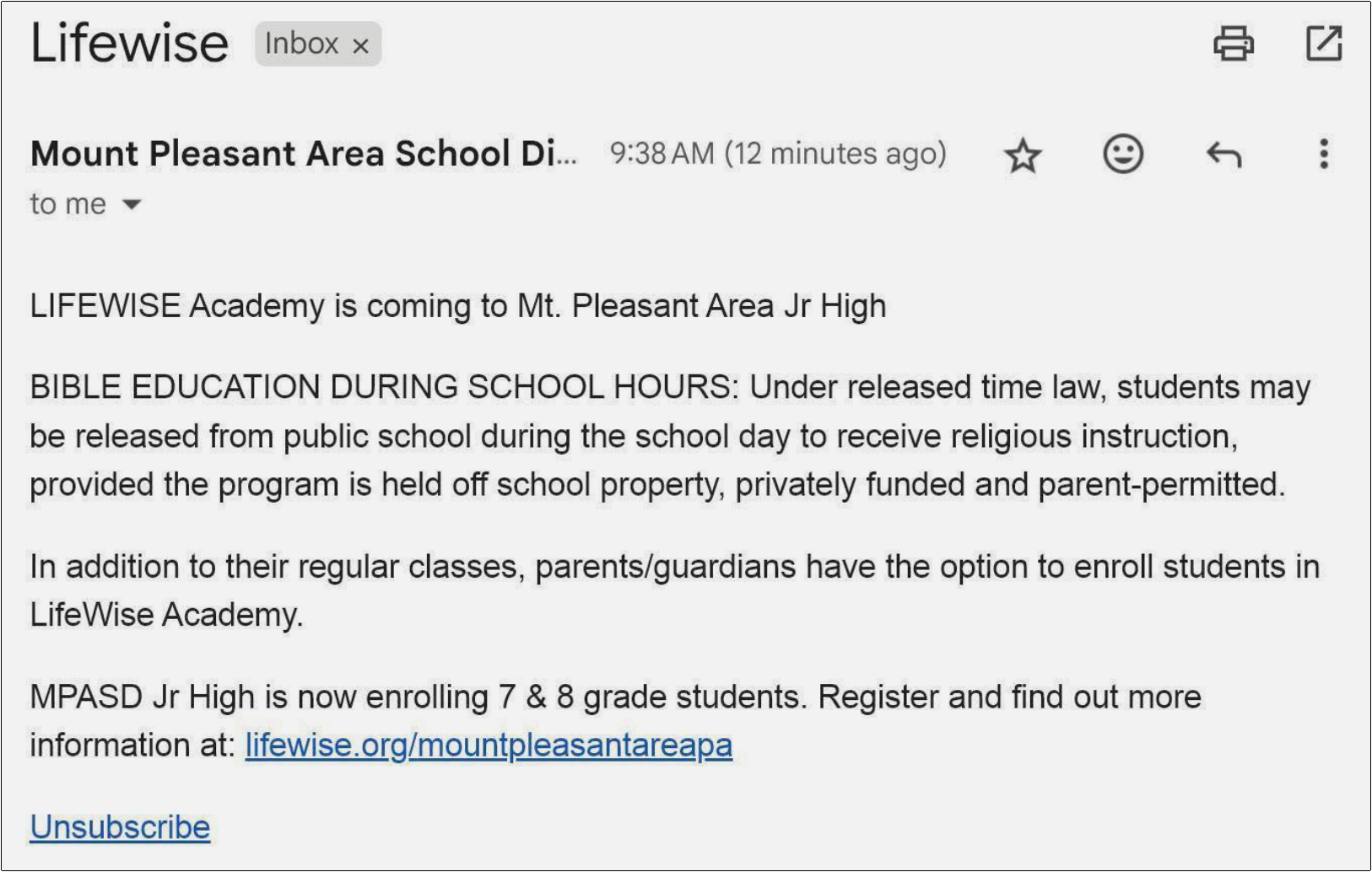
As reported to the Secular the Education Association (Pennsylvania):
Via Island Packet (South Carolina):
“…school districts may allow religious released-time education if it meets three criteria: courses must be off school grounds, be privately funded and students must receive their parents’ permission.”
Via Moore County News (Tennessee):
“…allows religious instruction during school hours for one hour per day under three conditions: 1) That the instruction takes place off school properties, 2) That the instruction is privately funded, not using government funds, and 3) That parents give permission for the instruction.”
Via Newport Plain Talk (Tennessee):
“…public school students can receive religious instruction during school hours, provided the program is off school property, privately funded, and they have parental permission.”
Via KTBS (Texas)
“In 1952, the Supreme Court ruled that students could be released from public schools during school hours to learn about religion if it was off school grounds, privately funded, and parent permitted.”
Via HeraldNet (Washington):
“The court ruled in Zorach v. Clauson that a released time program in New York was constitutional because it was off school property, did not use public funding and required parental approval.”
Via The Intelligencer (West Virginia):
“‘It’s off school property, it’s parent permission and it’s privately funded.’”
What the law actually requires
LifeWise Academy’s messaging reduces release-time religious instruction law to three conditions — off-campus, parent-permitted, and privately funded. Yet as Zorach v. Clauson (1952) and McCollum v. Board of Education (1948) make clear, the true constitutional boundary rests upon public school neutrality — that schools neither encourage nor discourage participation in RTRI programs.
Omitting that requirement, LifeWise has helped create a widespread but incomplete understanding of RTRI legality — one that continues to spread as the organization’s local programs expand nationwide at a rapid pace.
As this series continues, we will examine how the omission of public school neutrality operates in practice: from LifeWise’s internal communications to the real-world consequences when a lack of school neutrality blurs into RTRI endorsement.
So glad you brought this front & center again. The 1st article I read about this was a number of years ago. Yet as many times as I've reposted & talked about this, always so many other things in the news continue to bury this. Damnit, this is like some version of Hitler Youth, shaping, warping & brainwashing Americas youth. It's diabolical!