

Previously in Part 1 of LifeWise Exposed multi-part Lies By Omission During School Hours series, we covered how LifeWise Academy’s oft-repeated legal formula “off school property, privately funded, and parent permitted” became the legal de facto public understanding of religious release-time instruction (RTRI) while omitting the constitutional requirement of public school neutrality.
Part 2 of Lies By Omission During School Hours details how the legal requirements of public school neutrality were established, what it is, and how LifeWise largely omits it.
Unless otherwise noted, all bold emphasis is solely attributable to LifeWise Exposed.
The part of RTRI law LifeWise doesn’t talk about: Public school neutrality
On the legality of RTRI, LifeWise’s media-focused messaging solely focuses on its “legal holy trinity” — off-campus, privately funded, parent permitted — while omitting the constitutional requirement public schools remain strictly neutral toward religion.
That neutrality standard originates directly from two cases heard at the Supreme Court of the United States that would ultimately define the legality of RTRI — of which LifeWise cites Zorach v. Clauson (1952) ad nauseum.
As seen below (clipped section here), and in Part 1 of this series, LifeWise cites the Zorach RTRI legal requirements of “off school property, privately funded, and parent permitted” repeatedly, but the constitutional requirement of public school neutrality is consistently left out.
By failing to state the legal requirement of public school neutrality, LifeWise omits or fails to state the complete legality of RTRI law.
Without such neutrality a lack of boundaries is present, under which LifeWise’s model risks crossing from a lawful accommodation into an unconstitutional endorsement of religion by a public entity.
In McCollum v. Board of Education (1948), the Court struck down a program allowing clergy to teach religion inside public schools during the school day, ruling that using tax-supported property and compulsory attendance time for religious purposes violated the Establishment Clause — in other words, a violation of the separation of church and state under the First Amendment.
McCollum established public institutions — including public schools — cannot lend their authority, facilities, resources, or compulsory attendance to advance religious instruction.
“To hold that a state cannot, consistently with the First and Fourteenth Amendments, utilize its public school system to aid any or all religious faiths or sects in the dissemination of their doctrines and ideals does not, as counsel urge, manifest a governmental hostility to religion or religious teachings. A manifestation of such hostility would be at war with our national tradition as embodied in the First Amendment’s guaranty of the free exercise of religion. For the First Amendment rests upon the premise that both religion and government can best work to achieve their lofty aims if each is left free from the other within its respective sphere.”
Four years later, Zorach v. Clauson (1952) clarified further where the boundary between church and state lies. The Court upheld New York City’s “release-time” program because instruction occurred off school grounds, used no public funds, and involved no public employees or endorsement.
“Government may not finance religious groups nor undertake religious instruction nor blend secular and sectarian education nor use secular institutions to force one or some religion on any person.”
Public schools were to do no more, and no less, than work with religious groups operationally to fit RTRI programming into the school day.
“…public schools do no more than accommodate their schedules to a program of outside religious instruction.”
In the Zorach decision, the Court addressed in no uncertain terms the constitutional requirement of public school neutrality not just once —
“The government must be neutral when it comes to competition between sects. It may not thrust any sect on any person. It may not make a religious observance compulsory.”
— but twice.
“The school authorities are neutral in this regard, and do no more than release students whose parents so request.”
Americans United for Separation of Church and State on RTRI legal requirements
Americans United for Separation of Church and State (AU) outlines the minimum RTRI legal safeguards per Zorach:
Release time classes cannot occur on school property
School resources, including transportation, cannot be used to promote or facilitate release time classes
School staff and officials cannot push, encourage, or promote release time classes
School staff and officials cannot participate in or review student work produced in release time classes
Parental consent is required to attend release time
Students cannot be punished for refusing to attend
As seen, public school influence and institutional power as a government entity must remain neutral toward RTRI programming.
LifeWise: ‘Public school neutrality’ mentioned four times, ‘legal holy trinity’ ad infinitum
LifeWise’s three-part interpretation of RTRI law is repeatedly used in program pitches, becoming the de facto — but legally insufficient — public understanding of RTRI.
Upon examination, public school neutrality is addressed within publicly-facing LifeWise content four times.
LifeWise’s website contains no information relating to public schools’ constitutionally required neutral stance or neutrality toward RTRI programming.
LifeWise’s landing page for educators repeats their incomplete RTRI “legal holy trinity,” but public school neutrality as a legal requirement is not presented.
“LifeWise is keenly aware of the need to keep public and religious institutions separate. We are diligent to adhere to relevant laws and policies, namely the maintenance of a program that is (1) privately funded, (2) off school property and (3) inclusive of only students with parental permission.”
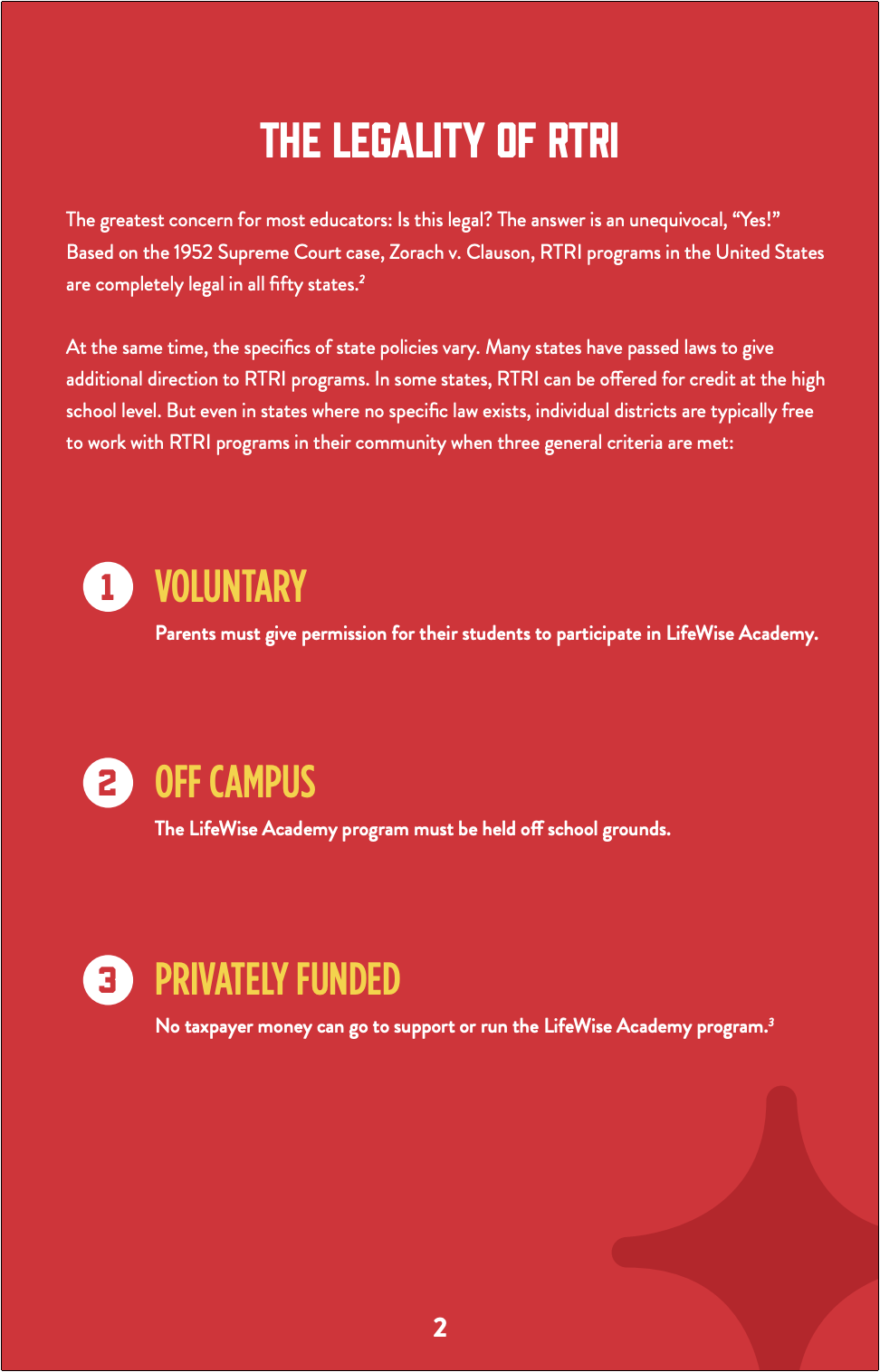
In a downloadable pdf guide entitled What Educators Need to Know About the Groundbreaking Released Time Program, LifeWise prominently features its incomplete three-part interpretation of RTRI law on page 2.
In the same downloadable guide, public school neutrality is referenced on page 9:
“While public schools cannot legally endorse any religious teaching or denomination, cooperating with a community-led RTRI program could provide incentive for these families to keep their students and influence in the public schools.”
In the FAQ on page 11:
“Legally, schools may not use class time or assemblies during the school day to promote released time programs.”
In DO’s and DON’TS on page 13:
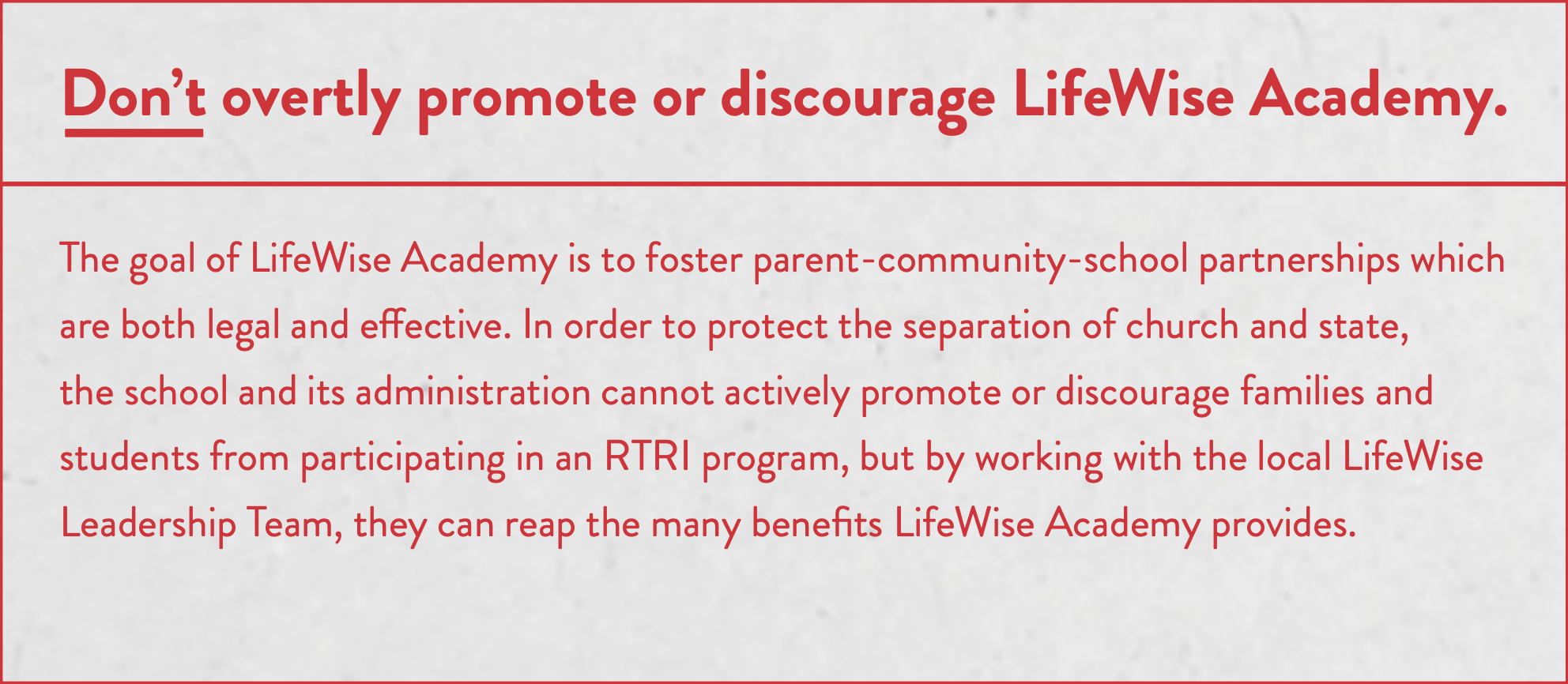
In his book During School Hours, LifeWise CEO Joel Penton addresses legally required public school neutrality once.
“…neutrality means that schools can neither encourage nor discourage participation in religious activities. The school and district cannot create or require a released time program; it must come from the community.”
LifeWise CEO Joel Penton redefines the meaning of “neutrality”
In During School Hours, Penton advances a novel but legally inaccurate definition of neutrality.
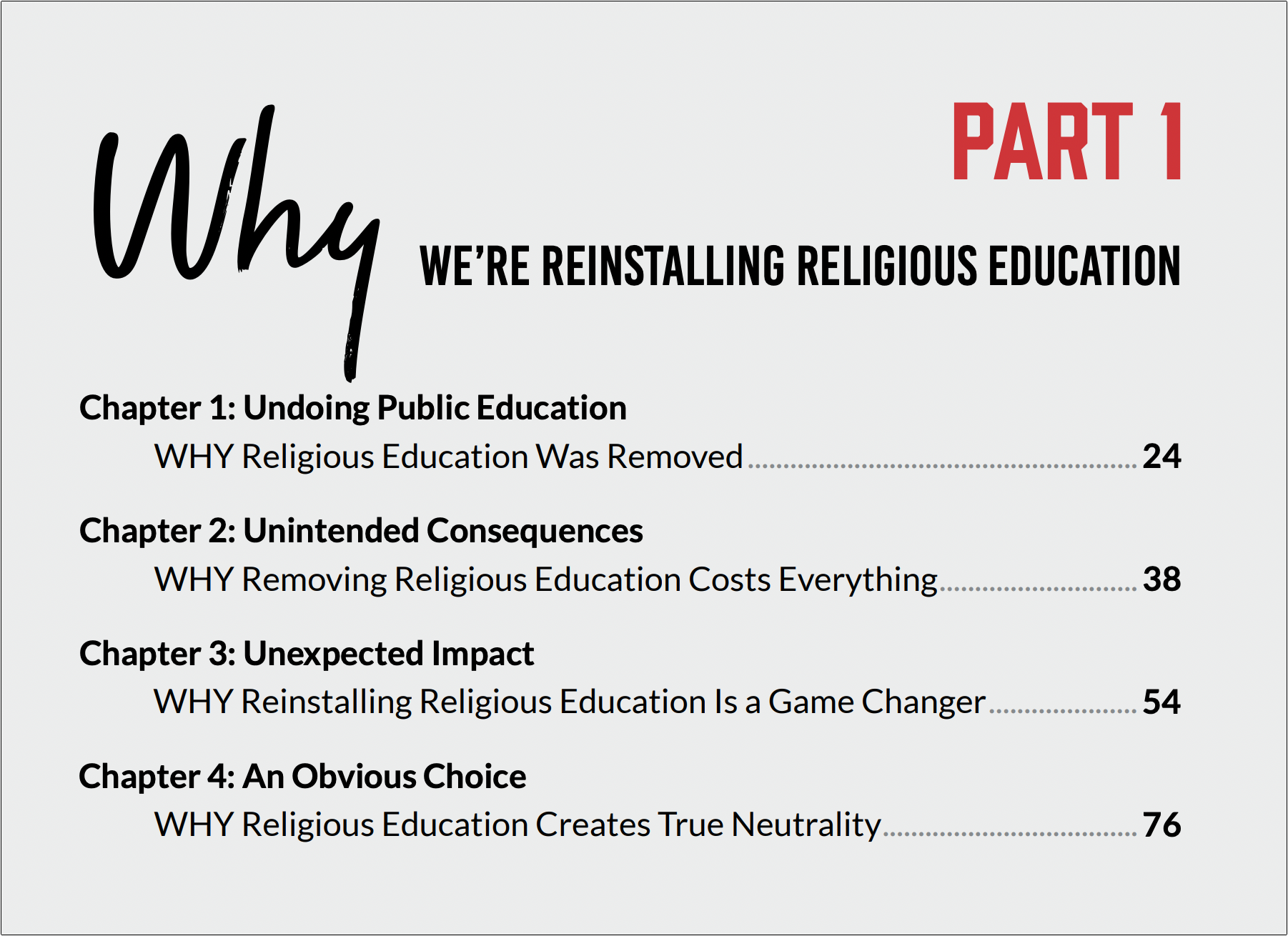
In chapter four “An Obvious Choice: WHY Religious Education Creates Neutrality,” Penton argues that RTRI programming creates “true neutrality,” claiming that a lack of religious instruction in public schools “isn’t neutrality.”
“ …silence isn’t neutrality.”
Penton goes on to say public schools’ lack of religious education is a discouragement of religion.
“We’re told, we must be silent on religion. Just religion. When it comes to the spiritual, schools actively discourage, root out, and refuse to speak about it at all.
And yet, sending a child to school for 30 hours a week and teaching him a vast array of details and disciplines but never mentioning the spiritual is, in fact, teaching something about the spiritual—it teaches that it’s unimportant. That it has no place. That it can (and even should) be ignored.
And that is not neutral. That is actively discouraging religion.”
In TheRooster interview Penton recounts participating in public school neutrality being broken to start LifeWise programs
Following public testimony on SB-229 at the Ohio capitol in November 2024— after which Ohio overrode school boards’ homerule of RTRI programs operating in district — Penton was interviewed by D.J. Byrnes of The Rooster.
In the interview, Penton tells of public school superintendents breaking their schools’ constitutionally required RTRI neutrality.
“…we get calls sometimes from public school administrators that say, ‘My kids are leaving, and going down the road where they have a LifeWise, when are you going to open up a LifeWise in my school?’”
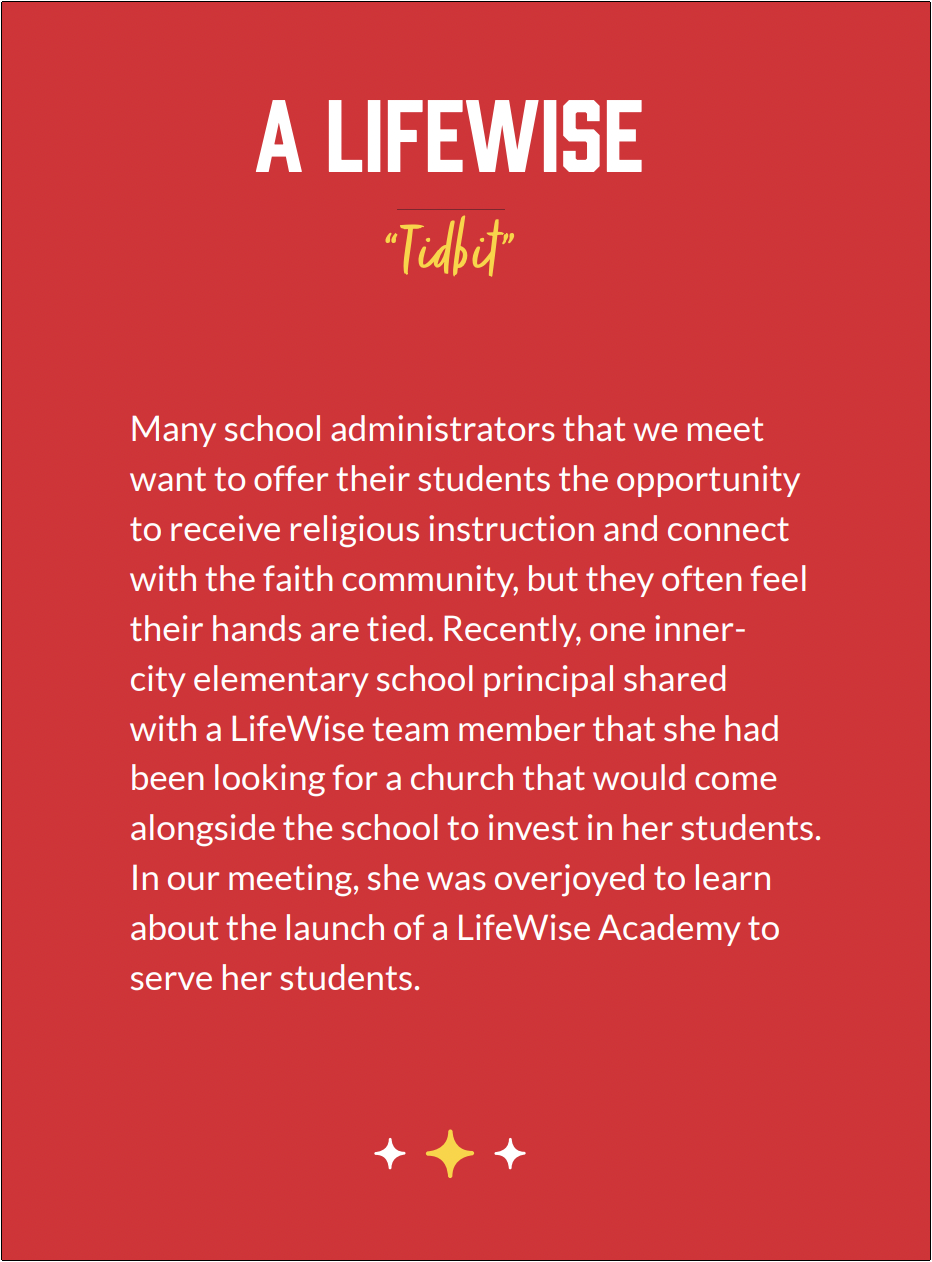
Additionally, During School Hours highlights multiple “LifeWise Tidbits” describing public school administrators desiring or asking how to bring LifeWise’s RTRI programming in district.
“…we got a call from an administrator in one of those neighboring districts asking how soon we might be able to expand the program to serve his schools.”
Penton does not directly state in During School Hours a school administrator’s inquiry of how to begin an RTRI program, or speaking of wanting to start a RTRI program, is a violation of legally required public school neutrality on RTRI.
Blurring neutrality, LifeWise’s Adam King meets with 60 public school educators
May 2014, a National Day of Prayer event was held at Zanesville High School in Ohio.
“The Muskingum County National Day of Prayer was held Thursday evening in the Zanesville High School cafetorium and featured prayers from community leaders for government, schools, families, businesses, churches, firefighters and law enforcement.”
The event also included remarks from Adam King, youth minister at New Hope Church and teacher at Zanesville High School, who emphasized the importance of mercy.
“It is exciting to get everyone in the community together and have the opportunity for prayer. I think that the church has lost its voice, and it is time to bring back mercy. God’s mercy is amazing.”
In 2015, a National Day of Prayer event would be held again at Zanesville High School
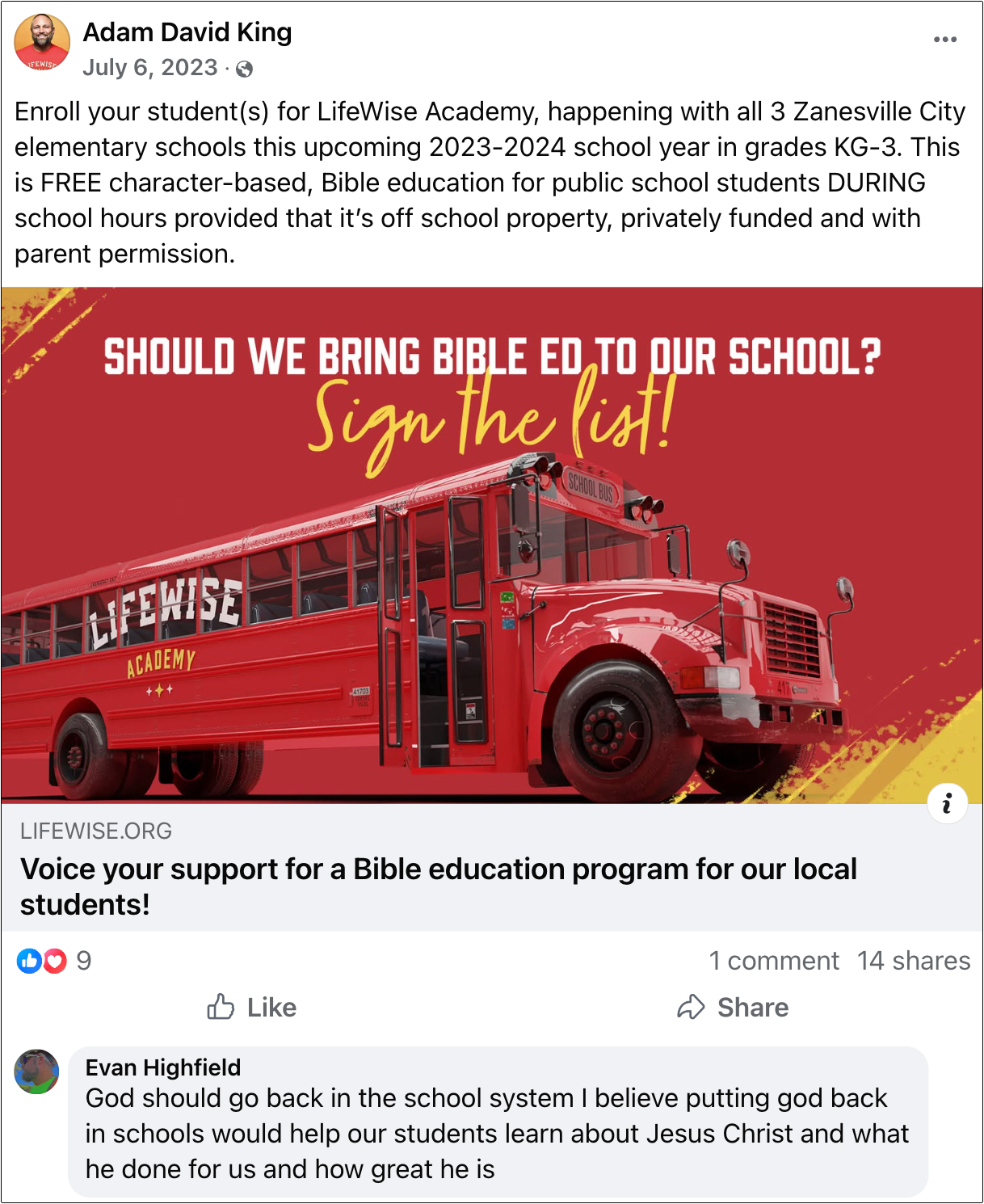
After working for 18 years in the Zanesville public schools as a biology teacher and then assistant principal until 2020, King started working part time for LifeWise June 2023 to bring LifeWise RTRI programming to Zanesville public schools.
In August, a few short months after starting, King was promoted to a full time Growth Representative after meeting a six-figure fundraising goal in just seven days for LifeWise corporate (as opposed to fully self-funded LifeWise local programs).
“…I’m happy to announce FULL-TIME employment with LIFEWISE ACADEMY @ the National Level. I started with them June 26 part-time & after hitting a 3 month 6-figure goal in just 7 days for the National Campaign…”
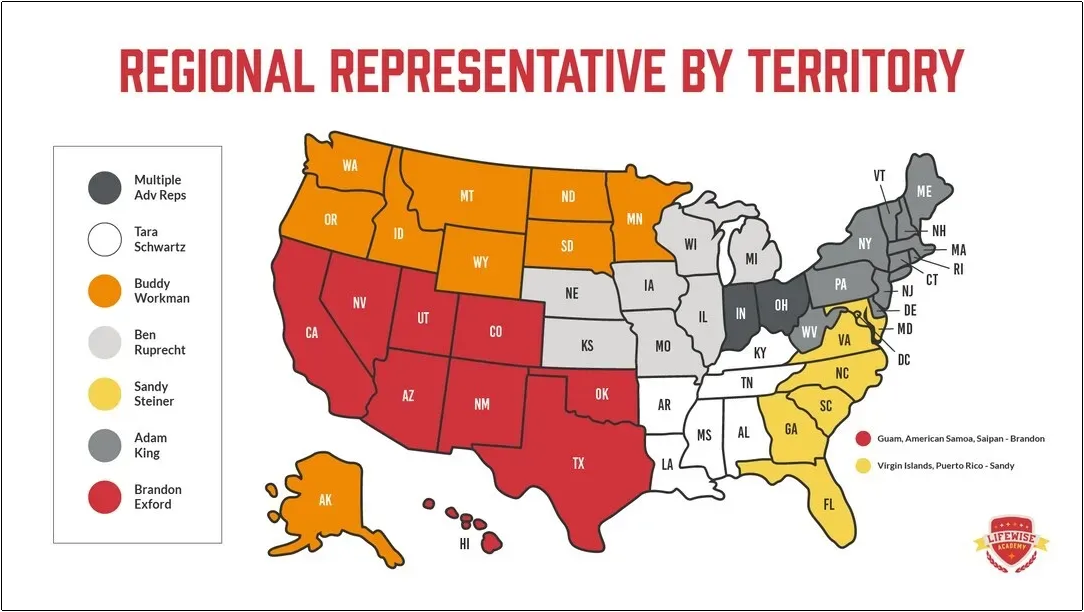
As a Growth Representative, King’s territories included southeastern Ohio, New England, most of the mid-Atlantic, and Washington, D.C.
“…assigned the SOUTHEASTERN quadrant of the state of OHIO (23 counties) and the NORTHEASTERN portion of the UNITED STATES including 12 states & Washington D.C.”
February 2024 at a LIFT gathering in Galion, Ohio hosted by Christian Educators, King met with 60 public school teachers.
“..presenting LifeWise this evening to a group of 60 public school educators at a LIFT gathering in Galion, OH (Crawford County). 🙏🏼🙏🏼”
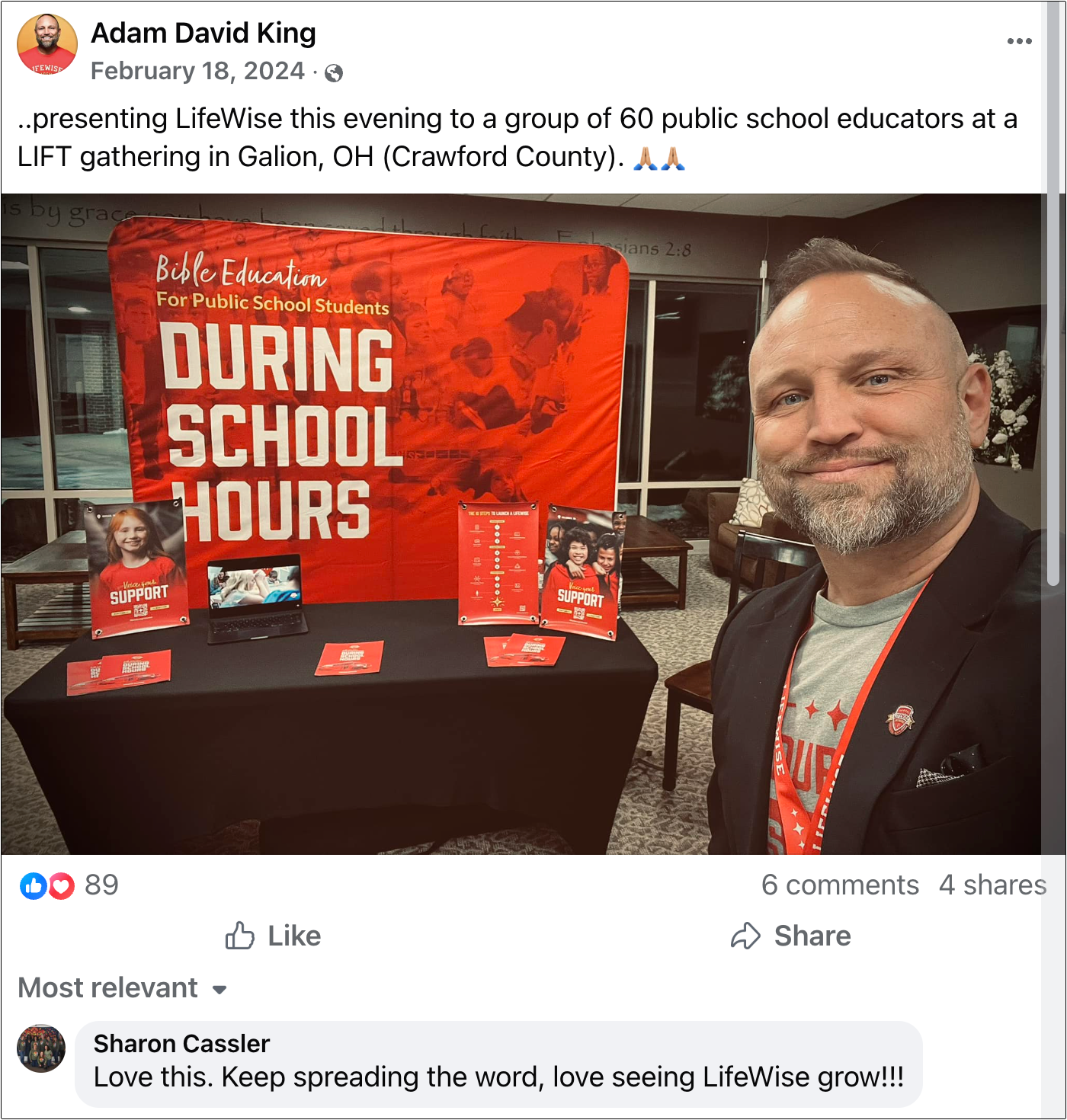
Christian Educators describes its mission to “…support, connect, and protect Christian educators in order for them to serve as thriving ambassadors for Christ in our schools.”
In July 2025, King was promoted to Director of Statewide Initiatives at LifeWise.
A final word on legal public school neutrality
When LifeWise omits public school neutrality from its three-part, rote narrative of “lawful” religious release-time, it isn’t merely communicating an incomplete understanding of constitutional law — it’s reshaping public understanding of it which plays out into real life consequences. The result is a national movement which enthusiastically presents itself as legally compliant while depending on public school cooperation that often crosses the Establishment Clause’s constitutional line.
From Penton’s legally irrelevant redefinition of neutrality, to public school administrators openly seeking to begin LifeWise’s RTRI programs in district, the boundary between religious accommodation and endorsement continues to blur wherever LifeWise operates.
Under LifeWise, what is presented as a “community-led” initiative increasingly depends on public institutions’ access, credibility, and resources that belong to the public — not to any religious mission.
The Supreme Court’s rulings in McCollum and Zorach remain clear: public schools may adjust their schedules for religious instruction, but they may not lend their authority or influence to promote it.
Public school neutrality is not optional — and RTRI is not legal without it.
Thanks for writing the article. The folks backing this are all intertwined with Project 2025 folks. Their main website is put together very well, but noticeably missing is any reference to Nationalism, the site makes it easy to type in your state, city & school to find nearest chapter, along with step by step simple instructions for how to get Lifewise into your kids school. I did a search typing in my grand kids school, in Wi, it would have been fairly simple to follow their instructions and start another chapter. It's chilling. Especially with children who attend, being encouraged to recruit other kids in class, by handing out invitations. Sadder still are some if the incidents that have come as a result teaching kids the gospel of hate. There's been reports of LifeWise kids bullying gays classmates, telling them unless they turn away from sin, they are monsters & will burn in hell. There's even 1 incident where 3 to 5 LifeWise kids beat the hell out of a transgender native American child in the school bathroom, she died a day later from head injuries sustained. They are little by little destroying our next generation of kids, our future leaders.
Atheists need to get a life instead of being obsessed with other people's religion.