


Please note: LifeWise Exposed draws a clear line between local LifeWise programs and LifeWise Academy corporate. Exempting screenshots, all bolded text is ours.
Despite LifeWise Academy’s rapid national expansion—projected to reach 100,000+ students across ~1,100 schools in 34+ states for the 2025-2026 school year—its financial model offloads nearly all operating costs onto local communities, even as LifeWise corporate reported revenue over $35 million in 2024 (155% increase over the prior fiscal year).
Local Burdens Build Corporate Profits
While volunteers and churches fundraise to keep their local LifeWise programs open, LifeWise corporate uses those same local programs to build a brand fueling national expansion while distancing itself from local programs’ daily realities, including child safety.
LifeWise corporate’s FAQ states:
“Our programs have been met with generous private donations acquired through local fundraising efforts.”
However, local LifeWise programs’ communications paint a different picture.
Carroll, OH – Despite LifeWise corporate stating in its FAQ, “Our programs are free to schools and families because of generous communities,” enrolled students’ families were asked to give $30 per month to keep the local LifeWise Bloom-Carroll program afloat.

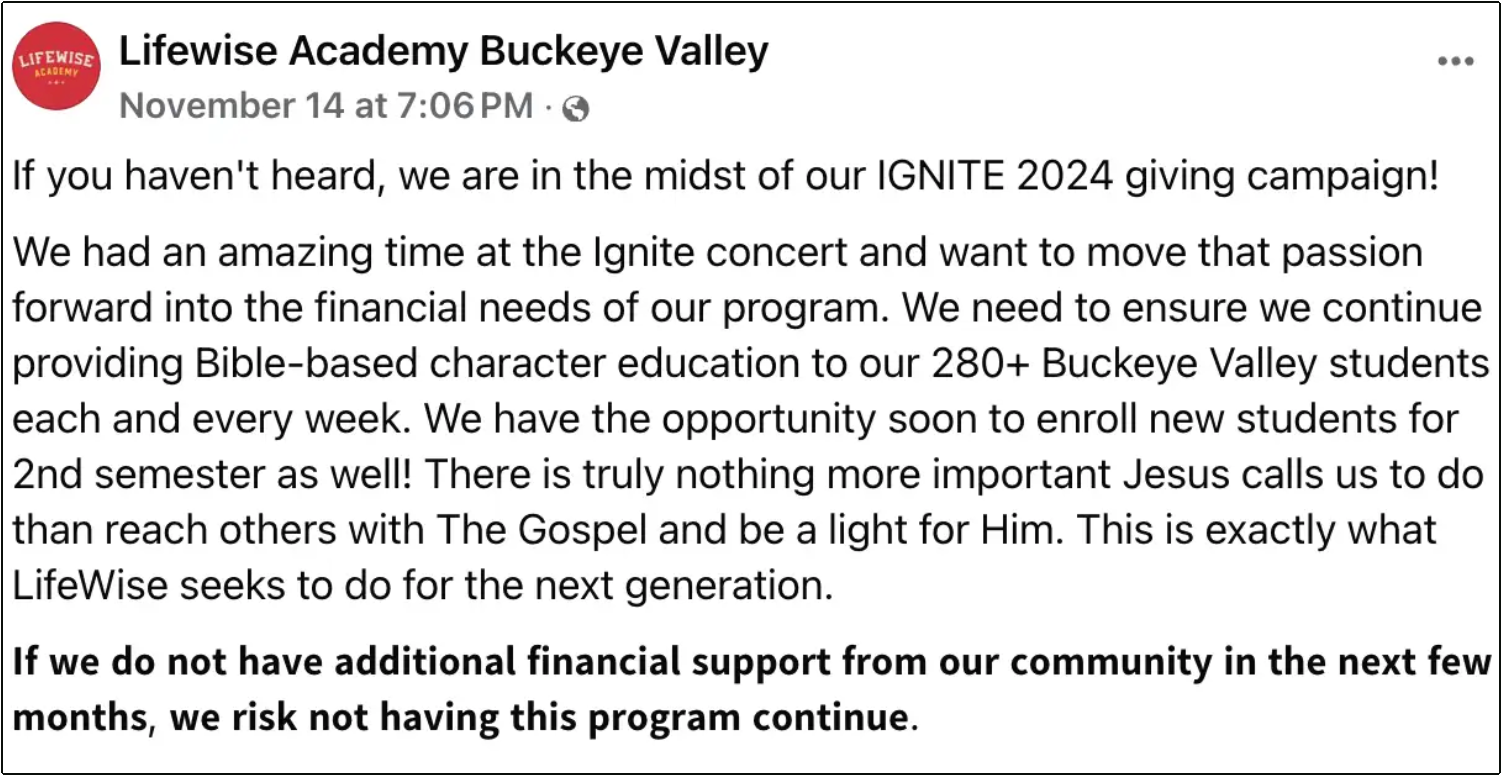
Delaware, OH – The local LifeWise Academy Buckeye Valley program warned it may be forced to shut down if enough donations were not received, stating:
“Each program is responsible for the costs of running our program including class material, bussing, maintenance, paying our teachers, etc.”
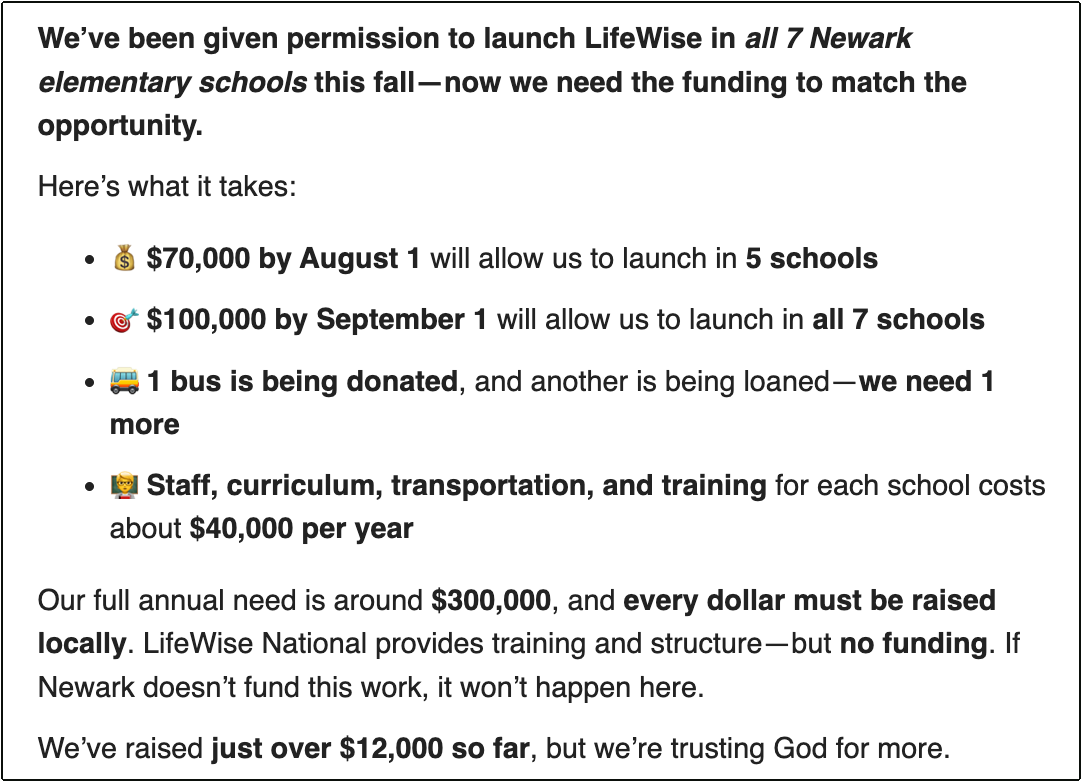
Newark, OH – Leaders at the local LifeWise Newark program scrambled to raise $100,000 in just a few months.
“Our full annual need is around $300,000, and every dollar must be raised locally. LifeWise National provides training and structure—but no funding. If Newark doesn’t fund this work, it won’t happen here. We’ve raised just over $12,000 so far, but we’re trusting God for more.”
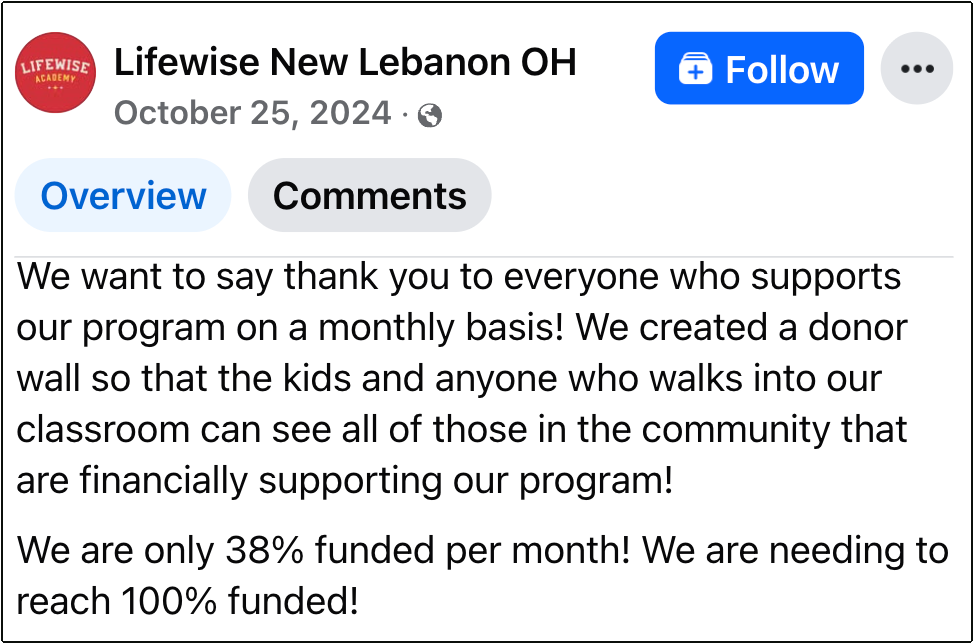
New Lebanon, OH – Pleading for community financial support, the local LifeWise New Lebanon program stated across multiple months it was only 20% to 38% funded:
St. Louisville, OH – The local LifeWise North Fork program sent an urgent plea for community financial support:
“This is not an easy letter to write; our North Fork Lifewise needs your help. …we are simply not getting the funding we need to sustain our program. As you know, Lifewise depends on donations to operate, as we get no funding from the schools.”
LifeWise Corporate: All the Money, None of the Responsibility
The fine print within LifeWise corporate’s company policies reveals a pattern of prioritizing its own revenue retention while shifting operational costs onto local LifeWise programs.
Despite stating local funds stay local, its own employee handbook states LifeWise corporate permanently controls all funds raised by local programs:
“All funds received by the program shall be the property of LifeWise… If a LifeWise program dissolves or disaffiliates, all funds and assets will be retained by LifeWise Academy LLC/LifeWise, Inc.”
Also in the employee handbook, LifeWise corporate states local program employees’ employer 403(b) retirement match will be taken out of community-fundraised local program funds:
“LifeWise, Inc. provides employees an opportunity to participate in its 403(b) retirement savings plan immediately upon hire… This 5% match will come from your program fund.”
At the very end of the LifeWise employee handbook are the financial performance program statuses of Yellow Zone and Red Zone:
Yellow Zone is defined as a fund balance that is less than two months of average operating expenses. Average operating expenses are calculated as an average of the previous six months of expenses…
The Red Zone is defined as a fund balance of less than $0.
When in Red Zone status underfunded local LifeWise programs may be penalized:
Local program director’s pay demoted to local minimum wage
Placed on a reimbursement schedule to payback LifeWise corporate
Permanent closure
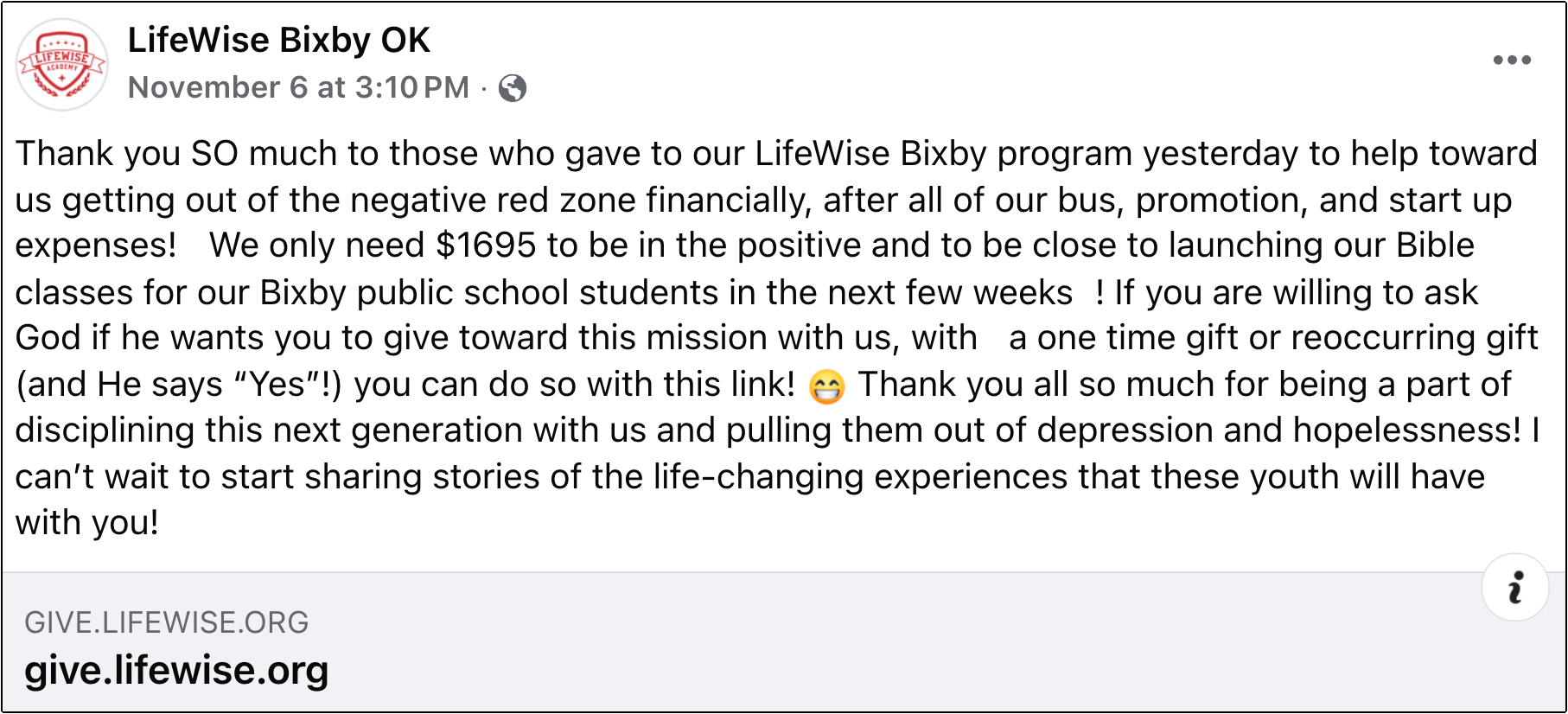
November 5, 2025, the not-yet-launched local LifeWise program in Bixby, Oklahoma posted an urgent funding plea stating they were in the Red Zone.
“…our program is in the negative $1,121. My goal is to get out of the red zone this week so that we can start raising money for curriculum, Bibles, and T-shirts for the kids ASAP for launching in a few weeks.”

Despite a bus being donated and other financial assistance, the next day on November 6, 2025, the Bixby LifeWise’s program negative balanced further increased to $1,695.
Conclusion
While LifeWise corporate has built an “almost like a franchise… very plug-and-play” model clearly replicable given its rapid national growth, this same model shifts local LifeWise programs’ costs onto the shoulders of America’s local communities—many of which may be rural or impoverished.
As LifeWise corporate coffers continue to swell year-over-year with near exponential growth, more and more local LifeWise programs — and their local communities — will be born into an environment of constant fundraising pressure to meet both their day-to-day operational costs and thousands in annual fees owed to LifeWise corporate.