


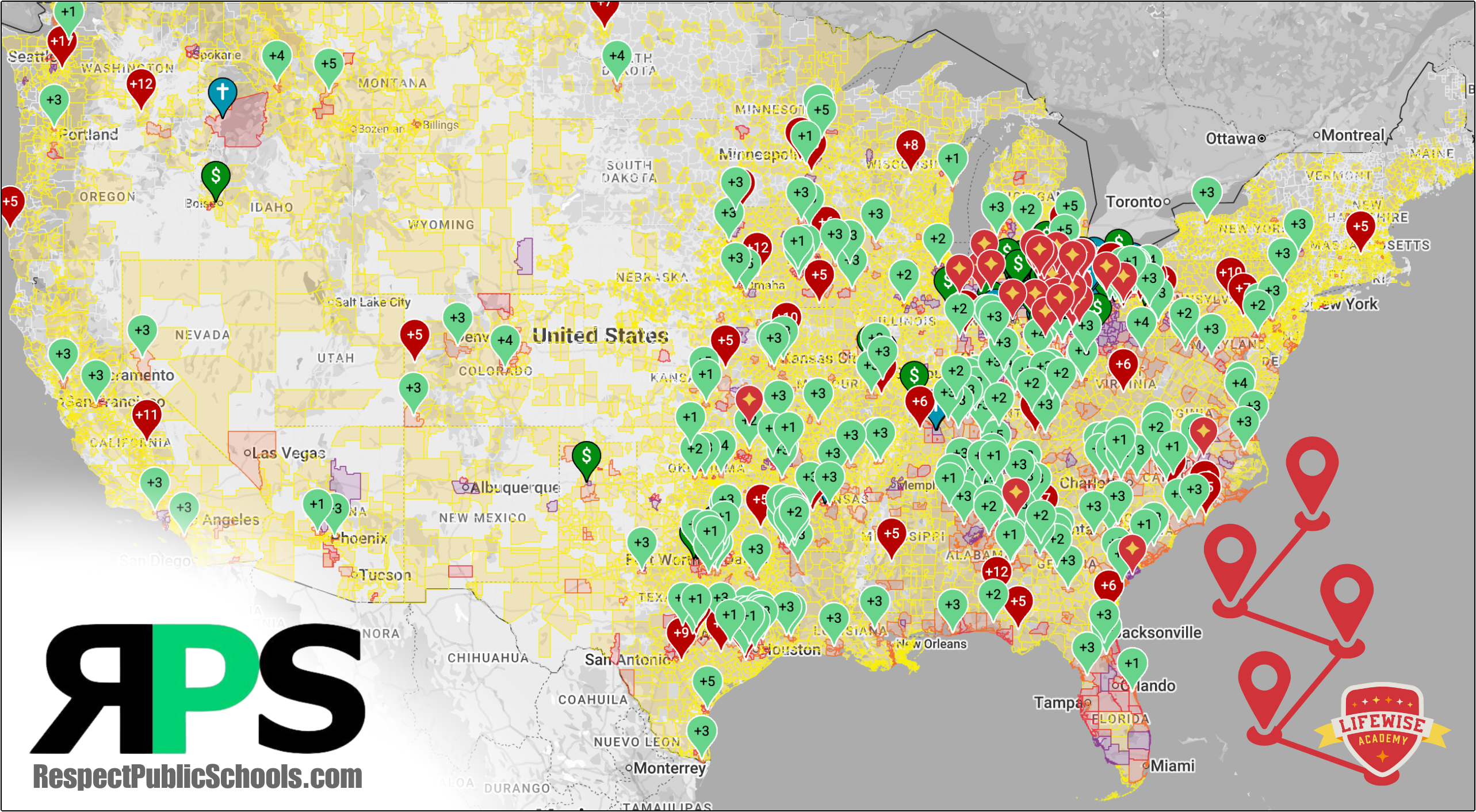
In a remarkable twist of transparency, LifeWise Academy’s own public data has become the foundation of the most comprehensive accountability tool tracking its rapid national expansion. The Respect Public Schools (RPS) map takes information directly from LifeWise’s website — data that they themselves publish — and uses it to show, in real time, how far their Release-Time Religious Instruction (RTRI) programs have penetrated into America’s public school system.
The RPS map is LifeWise’s own data, mapped for public visibility and oversight.
Unless otherwise noted, all bold emphasis is solely attributable to LifeWise Exposed.
RPS map born tracking LifeWise, felony legal threats from LifeWise corporate follow
Developed and owned by Keith Comer, the RPS map was born out of curiosity and civic engagement; Comer tells the story of his map here.
In 2024, Comer began researching HB 445, a bill that would force every school district to adopt policies allowing RTRI programs — by updating language in the current RTRI law from “may” to “shall” — thus making it easier for LifeWise to expand.
Curious how widespread LifeWise already was, Comer scraped publicly available data from LifeWise’s website, mapping petitions and launch steps across the United States utilizing Google Maps data.
In April 2024, Comer received a cease-and-desist letter from LifeWise’s attorney at Ashbrook Byrne Kresge & Flowers stating the organization’s copyrighted assets and intellectual property were violated by Comer’s RPS map; Comer was threatened with felony prosecution unless he deleted the map.
On the same day, the Hilliard, Ohio Police report taken by Officer Toczek concluded the opposite:
“At this point in time I do not believe a crime has occurred given that all the information being shared by [redacted] on his website is publicly available from LifeWise.”
In Hilliard, OH police report LifeWise COO Steve Clifton explains usefulness of RPS map
In the same police report filed with Hilliard, Ohio police taken by Officer Toczek, LifeWise COO and CFO Steve Clifton explained the value of the RPS map.

“…created a way for people that don’t like their organization to easily find every location approach the local Lifewise program. Clifton stated the information is publicly available but without the map [redacted] created you would have to look at 13,000 individual pages to find the information.”
In the same police report, Clifton also references a “hate group” that had tripled in size in opposition to LifeWise.
LifeWise public 10-Step RTRI data drives RPS map
LifeWise’s website — which tracks each local LifeWise program’s petition, progress, and 10-step launch process — is built directly upon public National Center for Education Statistics (NCES) data. NCES is the principal federal agency responsible for collecting, analyzing, and reporting data on education in the United States.
Notably, NCES data is literally baked into LifeWise’s website taxonomy, every local LifeWise program’s landing page uses the district’s NCES ID in the landing page URL.
The RPS map simply reverses the direction of that transparency, using LifeWise’s own publicly available data — as permitted under Fair Use doctrine — to track, visualize, and document LifeWise’s entry into public education during school hours.
In short: First LifeWise built its public RTRI program expansion dataset, then Comer developed the RPS map to publicly monitor and track LifeWise’s expansion into public schools.
A visual mirror and interactive platform built on LifeWise’s own 10-Step RTRI tracking system
The RPS Map is a direct data mirror of LifeWise’s public tracking on its website. Every district’s progress — from “interested community” to “active during-school program” — is displayed as LifeWise reports it.
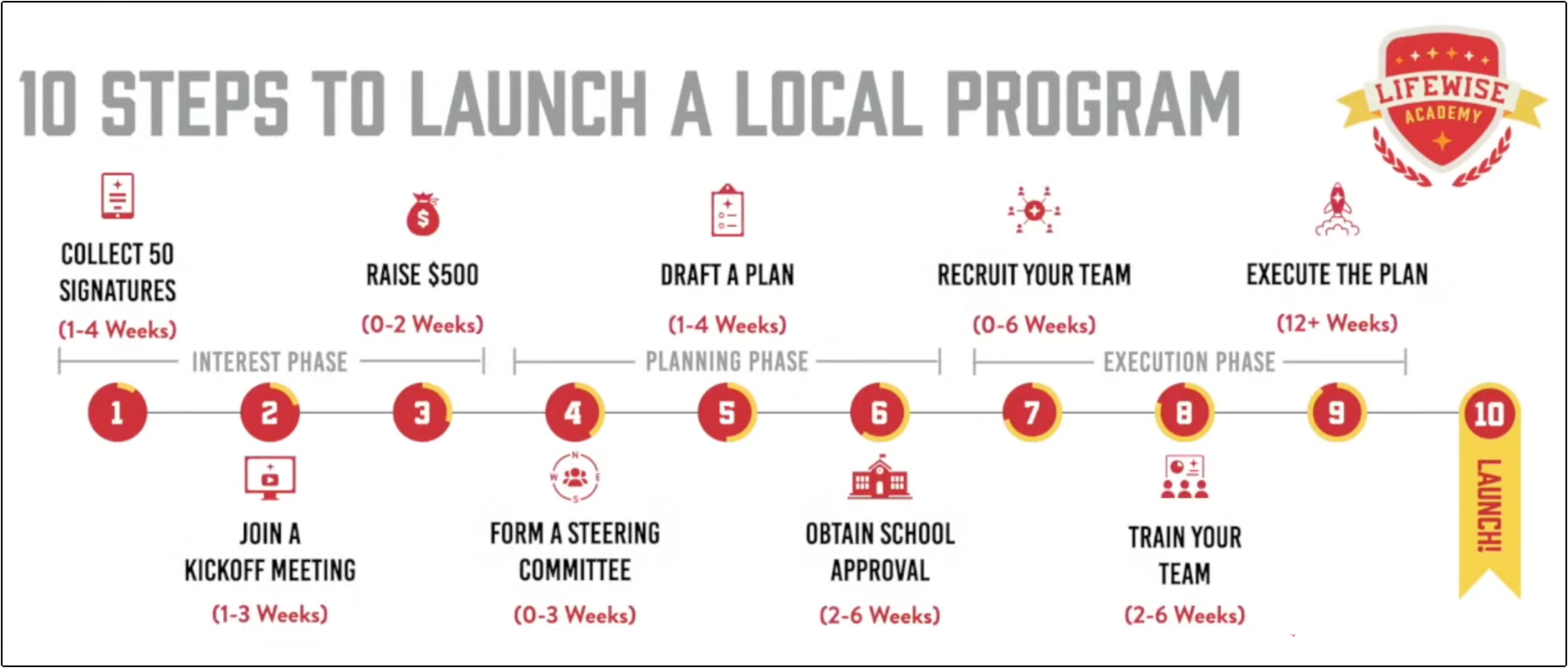
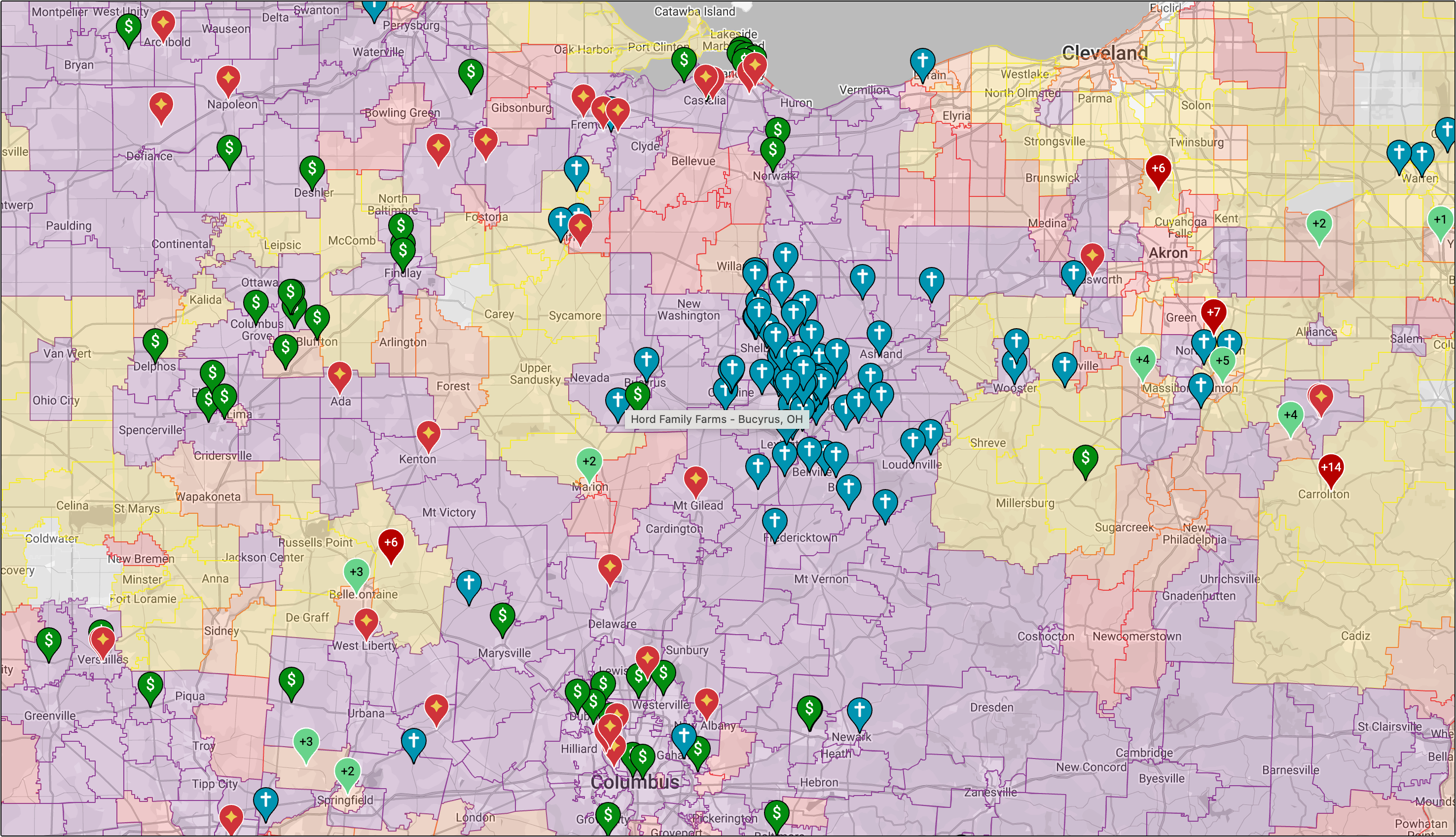
The map’s color-coded step system visually matches LifeWise’s own 10-step pipeline:
⬜ Gray: Step 0 — No known LifeWise activity
🟨 Yellow: Steps 1–3 Interest Phrase — Early petition and community formation
🟧 Orange: Steps 4–6 Planning Phase — Organizing and school board approval
🟥 Red: Steps 7–9 Execution Phase — Approved program pending, preparing to launch
🟪 Purple: Step 10 Launch Phrase— Active during-school LifeWise RTRI programs
Each color indicates where each potential LifeWise RTRI program is, and what it’s next step will be.
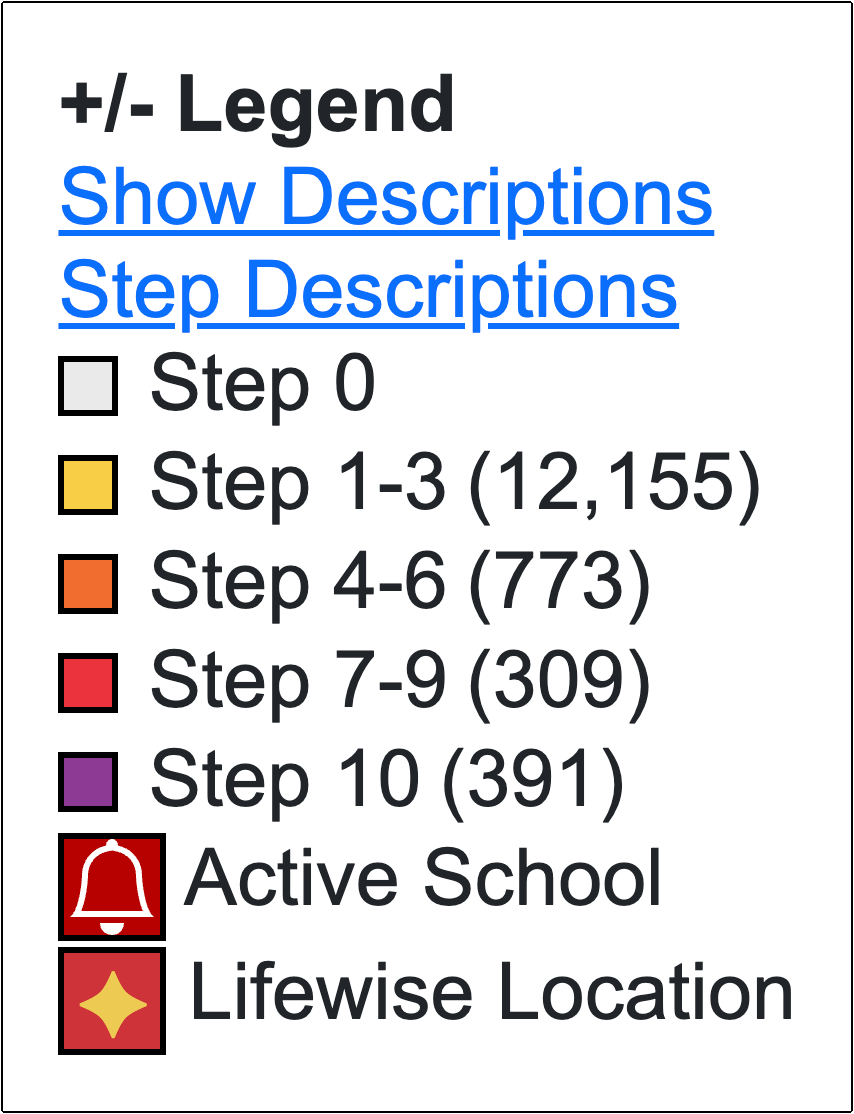
LifeWise Academy 10-Step RTRI program launch process
Collect 50 Signatures: LifeWise requires gathering at least 50 online “interest list” signatures. LifeWise states signatures should be locally-based, but LifeWise CEO Joel Penton has stated signatures can be “plucked out of the air” from “anyone with a pulse.”
Watch a Kickoff Meeting: After reaching 50 signatures, LifeWise invites signers to a virtual kickoff meeting led by local hosts and LifeWise staff, where the 10-step process, fundraising goals, and steering committee formation are introduced.
Raise $500: Communities raise a minimum of $500 — often during or soon after the kickoff meeting—to prove local engagement and the financial ability to move forward. Local LifeWise programs are fully self-supporting with no direct financial support from LifeWise corporate.
Form a Steering Committee: A 3–9 member steering committee, drawn from at least three churches approved by LifeWise, is established to represent the program and coordinate next steps.
Draft a Plan: The committee develops a logistical plan detailing location, schedule, and transportation for RTRI classes, which are usually held in nearby churches or offsite facilities in proximity to the targeted school(s).
Obtain School Board Approval: Finalized plan is presented to the school district or superintendent for authorization, often with no or limited public input; approval letters are issued without clear disclosure of which class times or subjects will be missed.
Recruit Your Team: The group recruits or hires a director, teachers, and volunteers to run the program, transitioning from the steering committee to a formal, long term local board.
Train Your Team: All staff complete training and background checks; directors and teachers receive specialized LifeWise instruction in person or online.
Execute the Plan: Preparations begin for launch — securing space, transportation, and enrollment—culminating local LifeWise program’s operational.
Launch Live LifeWise RTRI Program: The program officially opens, offering during-school religious classes to participating students under the district’s release-time policy.
Stay one step ahead
The most powerful feature of the RPS map isn’t just all-in-one-place visibility — it’s foresight. Because LifeWise’s petition process and 10-step system are publicly accessible, the RPS map enables users to proactively stay ahead of LifeWise activity at the school, district, regional, or state level.
By tracking where programs are in Steps 3–6, educators, community members, parents, and the media can anticipate when a community might be on the verge of approving a LifeWise program — and act before it becomes approved.
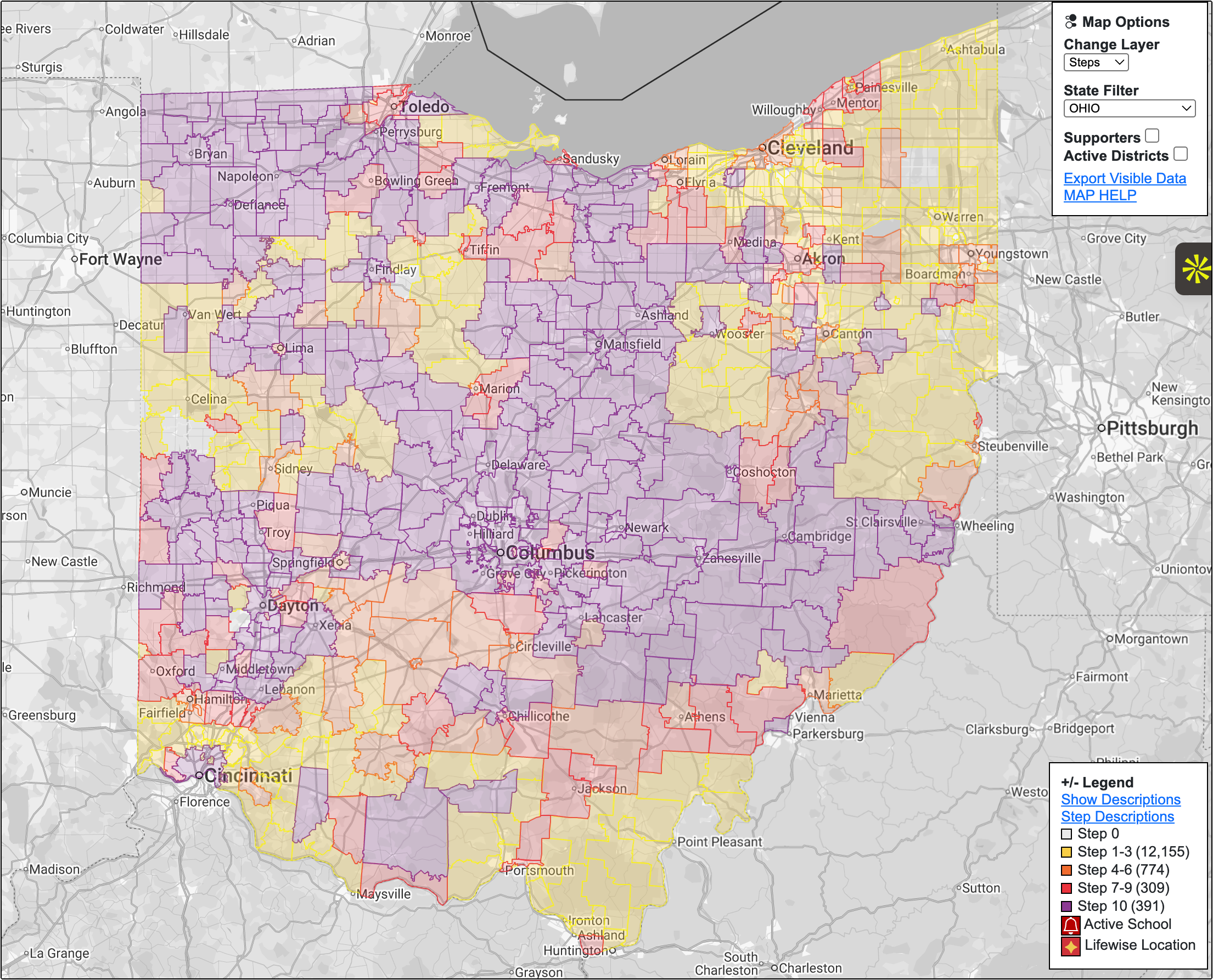
Users can also highlight individual states, greying out the rest of the country for clearer focus during presentations, research, or reporting.
13,000 districts, 128,000 public schools
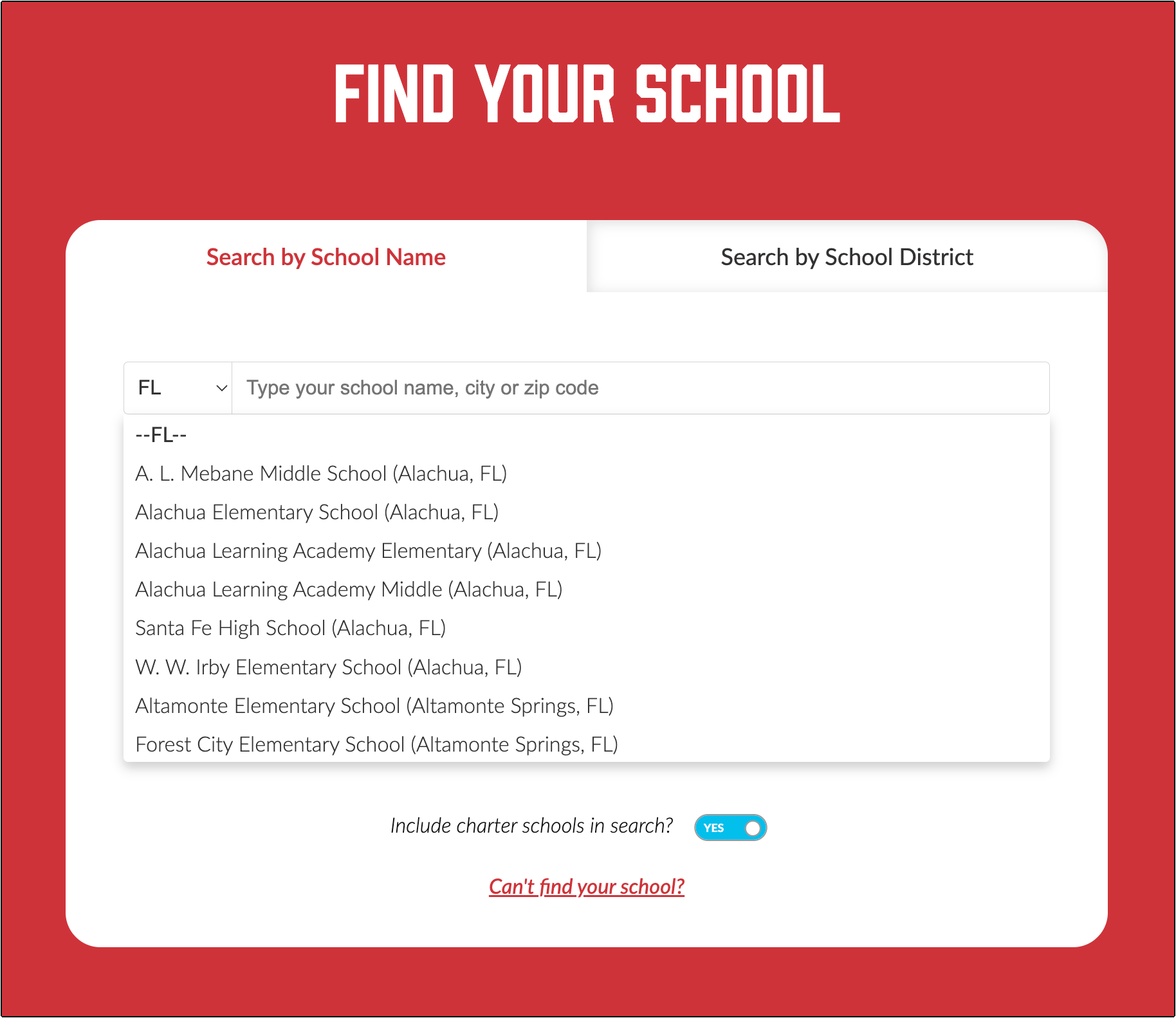
Just like on LifeWise’s find your school search page, every single public school district in the United States is represented on the RPS map — covering over ~128,000 schools across ~13,000 districts. This complete national dataset allows users to zoom out for a bird’s-eye view or zoom in to analyze local patterns in detail.
Additional layered data for critical context
LifeWise’s own data only shows where they’re expanding. The RPS map adds what they leave out: context. Overlaid onto the RPS map are additional data layers that make the picture sharper and more revealing:
District poverty levels — revealing possible socioeconomic patterns in expansion
Non-white student enrollment — highlighting demographic disparities in expansion
State RTRI laws — color-coded by legal category:
🟦 Navy Blue: “Shall Allow” — State law requires schools to permit RTRI if requested
🩵 Light Blue: “May Allow” — State law allows, but does not require, schools to approve RTRI programs
⬜ Gray: No RTRI Law — State has no statute authorizing RTRI
Together, these layers turn the RPS map into not just a tracker — but a state policy and demographics visualization tool.
District and school-level RPS map tracking pages
Each school district on the RPS map has its own dedicated landing page, providing:
District and/or school’s current LifeWise step, program status, with timestamp
A direct link to LifeWise’s official petition page for that district
Number of petition signatures
Link to the district’s NCES profile, which includes:
School or district’s name, address, grade span, and student/teacher ratio
Up-to-date data on student enrollment, demographics, and poverty levels
Links to the district’s official website and state education resources
If available:
LifeWise enrollment
Associated/sponsoring organization(s)
Local LifeWise program personnel
School district policy and state law
This interconnected structure makes the RPS map a direct bridge between federal data, LifeWise’s local RTRI program tracking system, and the communities being impacted — a fully transparent, data-driven ecosystem.
View supporters, donors, active LifeWise locations
As available, active LifeWise local RTRI programs, donors, and churches can be filtered on the RPS map.
Not just a map: Respect Public Schools’ tools
The Respect Public Schools platform goes far beyond mapping LifeWise’s reach — it exposes the networks, data, and misinformation driving their expansion.
The RPS business directory identifies organizations and churches backing LifeWise programs. The knowledge base provides clear, sourced information on RTRI law and events.
The RPS program statistics dashboard tracks LifeWise’s growth by step and demographics; state-specific dashboards are also available.
RPS challenges LifeWise’s claims that RTRI participation “improves attendance” — data shows no evidence of such benefit.
The RPS YouTube channel and Facebook page share insights, video briefings, and real-time updates.
Fair Use and civic accountability
Under the Fair Use doctrine, RPS repurposes LifeWise’s public data for commentary, research, and education — all purposes protected under United States law.
Where LifeWise uses NCES data as a framework to expand religious instruction into public schools during, the RPS map uses LifeWise’s public data to alert and inform communities, and protect constitutionally required public school neutrality
It’s not just data visualization — it’s public accountability mapped against targeted public schools.
Explore the Respect Public Schools map, sound the alarm
Visit RespectPublicSchools.com to explore the fully interactive local LifeWise RTRI program tracking map.
Zoom in on your state, click your district, and see exactly where LifeWise stands — and where they’re headed next.
Every color, every pin, every link is the beginning of a story of how LifeWise sought entry into a public school through the influence of people, organizations, and money.
LifeWise Academy wrote the playbook, a proven 10-step process for public school entry — Respect Public Schools mapped the defense and counter-strategy.
Thank you for your work and commitment to tracking LifeWise's assault on public schools and the constitutionally mandated separation of church and state. We are using this data to stop its entry into the Buncombe County Schools. Your work matters!