

Before getting into released time for religious instruction (RTRI) policy frameworks, safeguards, or model language, it’s worth stating plainly — because too many school districts and public education advocates are missing this fundamental truth entirely:
The best RTRI policy is no RTRI policy at all
That’s not rhetorical — it’s strategic.
Unless your school opts to allow released time operations during the school day — in which case it is always recommended to implement a strong RTRI policy — simply adopting an RTRI policy may expose a school to risk.
An RTRI policy does not just create guidelines and enforceable accountability, it also establishes an entry point for organizations like LifeWise Academy to more easily infiltrate public school districts.
An RTRI policy signals that a district may accommodate released time programs
A school’s RTRI policy establishes the infrastructure needed for released time programs to begin operations — and with the majority of states already mandating excused absences for holy days religious accommodations are already available for many students.
However, the presence of a district’s RTRI policy can put that public school on the radar of LifeWise and similar programs, effectively placing it at the top of their list due to the ease of entry.
The inverse is also true: in states where no law requires RTRI, the absence of a policy can act as a deterrent. Without a formal mechanism in place within existing school policy, there is no clear pathway for a released time program to seek access without a school potentially throwing up additional hurdles.
This distinction matters depending on the state in which a district is located and that state’s RTRI statute (or lack thereof)
Released time statutes will vary by state. In states with no RTRI statute where released time access is entirely left to individual school districts, legal experts generally agree that the safest course of action is to avoid adopting a released time policy altogether.
States with no RTRI statute:
Alaska
Arkansas
Colorado
Connecticut
Delaware
District of Columbia
Georgia
Kansas
Louisiana
Maryland
Mississippi
Missouri
Nebraska
Nevada
New Hampshire
New Jersey
North Carolina
Rhode Island
Virginia
Washington
Wyoming
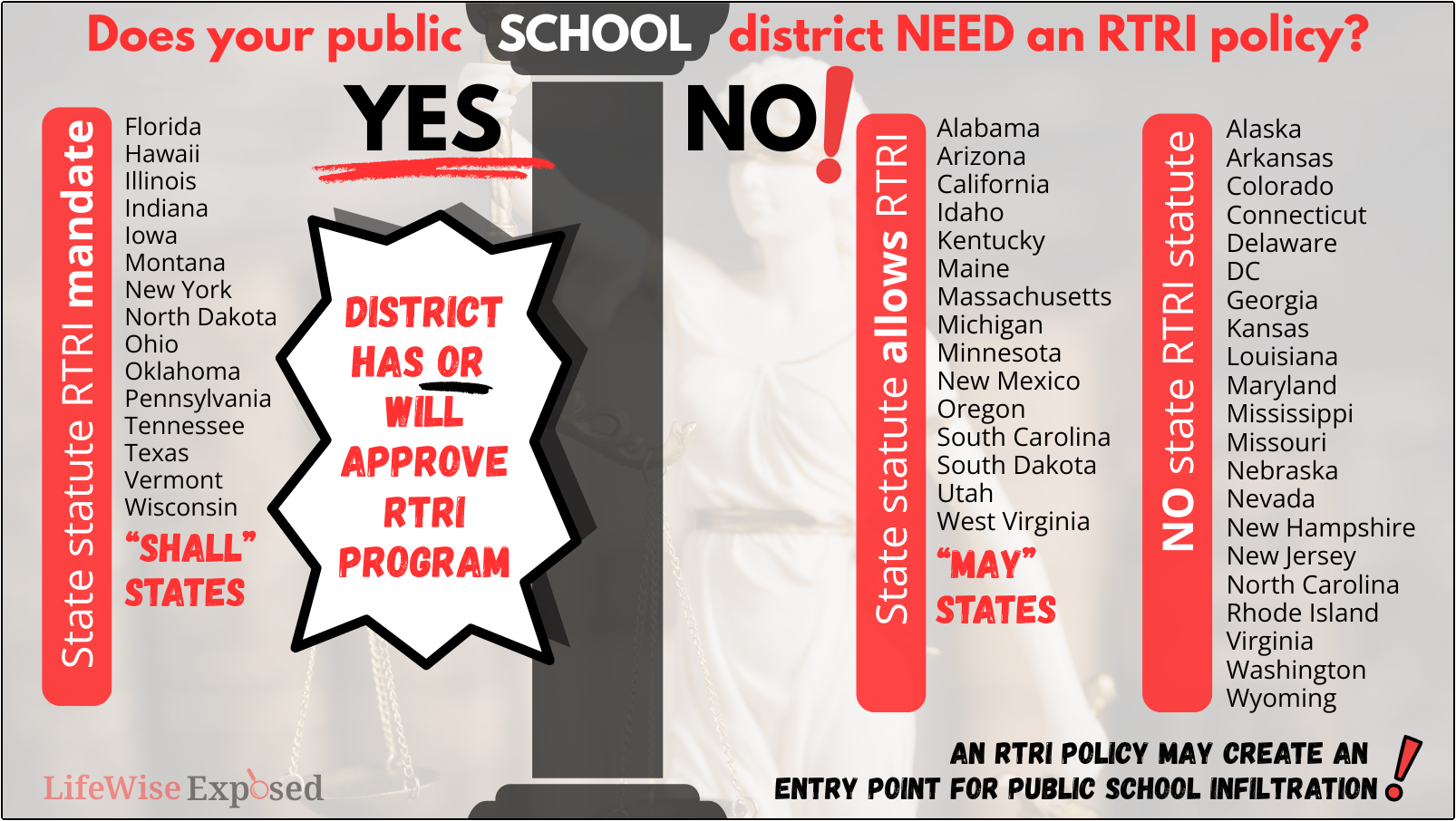
In so-called “may” states where RTRI is permitted but not legally required, districts still retain discretion and home rule. Here too, simply not adopting an RTRI policy may be the most effective way to avoid the entry of a released time program intent on removing children during the school day.
States with an RTRI statute, where districts “may” allow RTRI operations:
Alabama
Arizona
California
Idaho
Kentucky
Maine
Massachusetts
Michigan
Minnesota
New Mexico
Oregon
South Carolina
South Dakota
Utah
West Virginia
States mandating RTRI require an ironclad, public education-centric released time policy
Only in “shall” states, where RTRI policies are mandated by law, do public schools lose autonomy to decline released time operations in their districts. In those states, the question is no longer whether to adopt a policy — but rather, how to do so without exposing students or the district to unnecessary risk and disruption of the school day.

States with a mandated RTRI statute, where districts “shall” (must!) allow released time operations:
Florida
Hawaii
Illinois
Indiana
Iowa
Montana
New York
North Dakota
Ohio
Oklahoma
Pennsylvania
Tennessee
Texas
Vermont
Wisconsin
How do you craft a strong RTRI policy?
As “shall” states require a strong RTRI policy, it is imperative that each school district design and adopt an RTRI which protects district liability, maintains the integrity of school day operations and students’ educational access, and limits released time programs’ encroachment.
This is where the latest RTRI model policies from Respect Public Schools and Respect Public Schools-WA come in — which we will examine next.